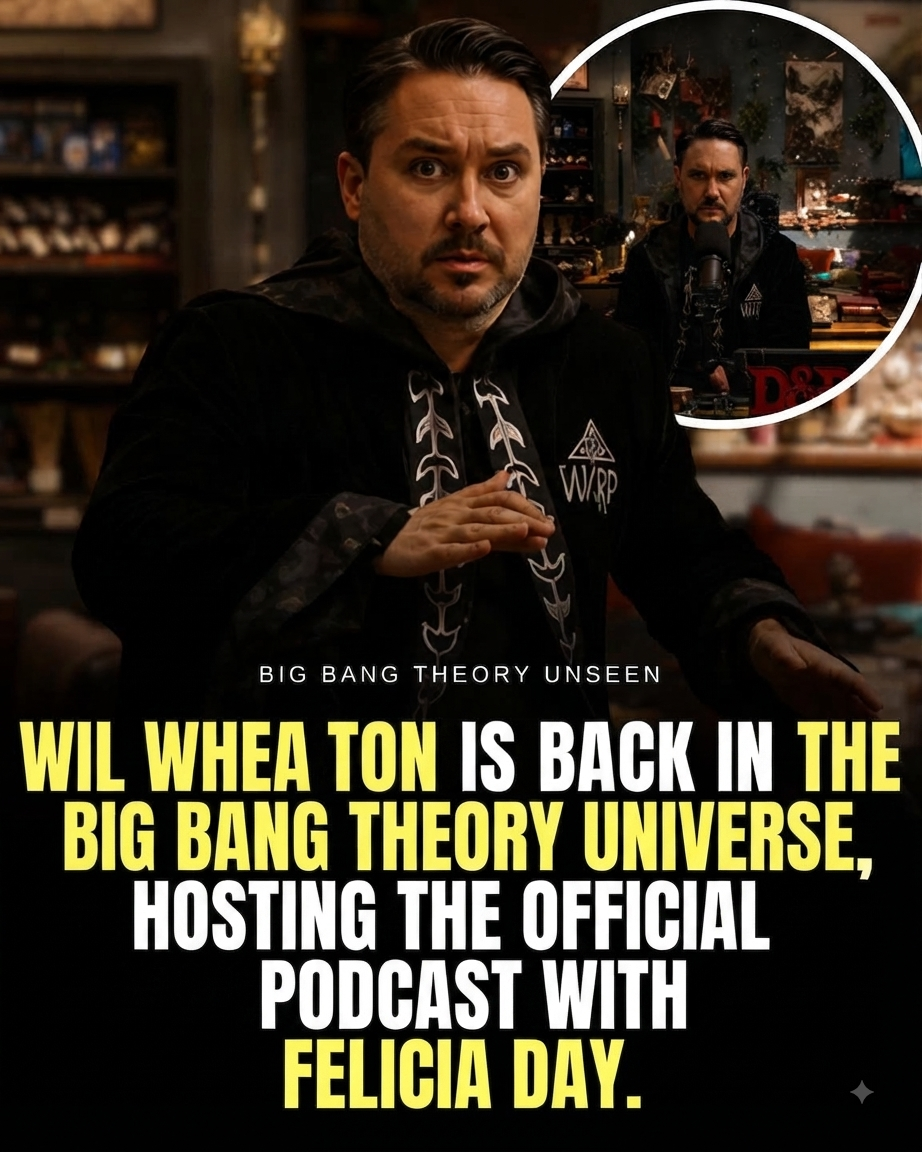
Few recurring guest stars in The Big Bang Theory developed a relationship with the show quite like Wil Wheaton.
When Wheaton first appeared as a fictionalized version of himself, the idea was relatively simple: take a beloved Star Trek actor, exaggerate his personality, and turn him into one of Sheldon's most unlikely enemies.
What followed became one of the show's longest-running and most entertaining recurring jokes.
Wheaton's version of himself became manipulative, competitive, occasionally petty, surprisingly vulnerable, and almost completely incapable of resisting an opportunity to annoy Sheldon Cooper.
Years later, the character has returned in Stuart Fails to Save the Universe — but this time, Wheaton's connection to the franchise extends beyond simply appearing on screen.
He's wearing two hats.
He's both a character in the new series and one of the hosts of its official companion podcast.
And that makes his return feel considerably more meaningful than a conventional cameo.
Wil Wheaton's Strange History With Sheldon Cooper
Wheaton's relationship with The Big Bang Theory goes back to the original series.
His fictionalized persona was introduced as someone Sheldon had admired as a child because of his role as Wesley Crusher on Star Trek: The Next Generation.
That admiration didn't survive their first major encounter.
Instead, Wheaton became one of Sheldon's most personal enemies.
The joke worked because Sheldon wasn't simply annoyed by Wheaton.
He was emotionally invested in him.
Sheldon had created an idealized version of the actor in his childhood imagination, only to discover that the real Wil Wheaton — or at least the fictional version played on the show — was capable of behaving in ways Sheldon found unforgivable.
That gave the character a unique position within the show's mythology.
He wasn't just another celebrity cameo.
He was part of Sheldon's emotional history.
From Enemy to One of the Show's Favorite Recurring Characters
One of the reasons the Wil Wheaton character became so successful was that the writers never completely abandoned his antagonistic side.
He could still manipulate Sheldon.
He could still exploit Sheldon's insecurities.
He could still turn up at precisely the wrong moment.
But over time, the relationship became more complicated.
Wheaton's character occasionally showed genuine affection for the group.
He became part of the larger social circle.
The character who had once represented one of Sheldon's greatest childhood disappointments gradually became something much closer to a friend.
That evolution mirrored one of the show's broader strengths.
Characters who initially existed as sources of conflict were rarely locked permanently into those roles.
They changed.
They became familiar.
And eventually, they became part of the family.
Now Wil Wheaton Is Back
Stuart Fails to Save the Universe gives Wheaton another opportunity to revisit that exaggerated version of himself.
The new series takes the original show's willingness to play with celebrity appearances and pushes it even further through its multiverse premise.
Characters can exist in radically different versions of reality.
The rules are different.
The relationships can be different.
And familiar personalities can be exaggerated to almost absurd extremes.
That makes Wheaton a particularly natural fit for the series.
His Big Bang Theory persona was already a fictionalized version of himself.
The new show simply has even more freedom to play with the concept.
But He's Not Just an Actor This Time
Wheaton's involvement doesn't stop when the cameras stop rolling.
He also co-hosts the show's official companion podcast with Felicia Day.
That gives him a completely different role within the franchise.
Instead of simply appearing inside the fictional universe, he's also helping audiences explore how that universe was created.
The podcast provides another layer of context for the series, with conversations about the show's characters, Easter eggs, multiverse concepts, and the creative decisions behind individual episodes.
It's an unusually fitting role for Wheaton.
After all, he has spent years occupying the strange space between actor, fan, and participant in genre culture.
Felicia Day Makes the Partnership Even More Fitting
Wheaton's podcast co-host, Felicia Day, is herself deeply connected to the world of genre entertainment.
Best known for projects including The Guild, Supernatural, and Buffy the Vampire Slayer, Day has spent much of her career working in the same broad fan culture that The Big Bang Theory frequently celebrated.
That makes the pairing particularly natural.
The two hosts can approach Stuart Fails to Save the Universe from slightly different perspectives while sharing a deep understanding of science fiction, fantasy, gaming and fandom.
The podcast therefore isn't simply promotional material.
It becomes part of the experience of watching the show.
The Podcast Expands the Universe Beyond the Episodes
One of the most interesting aspects of the companion podcast is its timing.
New podcast episodes are released alongside the corresponding installments of the series.
That allows the discussions to function almost like an additional layer of the show.
An episode can introduce a strange new universe or resurrect a familiar character.
Then the podcast can provide context.
Creators can explain why a particular decision was made.
Actors can discuss how a scene was filmed.
And fans can hear about details that might otherwise remain invisible.
For a franchise as packed with references as The Big Bang Theory, that's particularly valuable.
Chuck Lorre, Bill Prady and Zak Penn Join the Conversation
The podcast also brings together the creative minds responsible for the new series.
Chuck Lorre and Bill Prady, who helped create The Big Bang Theory, return to shape the franchise's newest chapter alongside Zak Penn.
Their involvement gives the podcast access to people who can explain how the show's unusual multiverse concept came together.
Rather than simply discussing what happens on screen, the conversations can explore the decisions behind it.
Why this character?
Why this universe?
Why this particular joke?
Why bring back this particular piece of Big Bang Theory history?
Those are precisely the questions longtime fans are interested in.
The Cast Gets Involved Too
The podcast also features conversations with members of the Stuart Fails to Save the Universe cast.
Kevin Sussman, Lauren Lapkus, Brian Posehn and John Ross Bowie are among the performers discussing the series and its behind-the-scenes details.
That creates another connection to the original show.
Sussman returns as Stuart.
Posehn returns as Bert.
Bowie returns as Kripke.
And Wheaton returns as Wheaton.
The new series isn't simply introducing an entirely separate cast into a new concept.
It's taking pieces of the old ensemble and placing them into a completely different storytelling environment.
Bill Prady Made the Connection Personal
Wheaton has revealed that his involvement with the new series wasn't something that appeared out of nowhere.
Bill Prady, who co-created The Big Bang Theory, is a real-life friend of Wheaton.
According to Wheaton, Prady told him about the project as far as three years before it premiered.
That meant Wheaton knew about the idea long before audiences did.
And his initial reaction was understandable.
A series centered on Stuart?
Really?
Wheaton admitted he was initially skeptical about the idea of an entire series built around Stuart Bloom.
It's hard to blame him.
For years, Stuart had been one of the most lovable disasters in the Big Bang Theory universe.
The idea of turning him into the central figure of an entirely new series was certainly unconventional.
But then Wheaton saw the trailers.
And his opinion changed.
“A Whole Series About STUART????”
That reaction is revealing because it captures exactly how unexpected the new series is.
Stuart was never the obvious candidate for a spinoff.
Sheldon already had Young Sheldon.
Georgie eventually received Georgie & Mandy's First Marriage.
But Stuart?
The comic-book store owner who could barely keep his business afloat and whose romantic life was perpetually disastrous?
That seemed like an unlikely foundation for another series.
And that's precisely why the concept is interesting.
The creators weren't simply repeating the most obvious formula.
They were taking a peripheral character and giving him an entirely new canvas.
Wheaton's Skepticism Became Enthusiasm
The fact that Wheaton changed his mind after seeing the trailers says something important about the project's ambitions.
The show isn't simply “another Big Bang Theory.”
It has a completely different tone and format.
The multiverse concept allows it to move into science fiction, fantasy and action-adventure territory while maintaining the comedy that made the original franchise successful.
For someone like Wheaton, whose career has always been deeply connected to genre storytelling, that makes the project particularly appropriate.
From Sheldon's Enemy to Franchise Insider
Wheaton's journey through the franchise is almost a story in itself.
He started as a childhood idol.
Then he became Sheldon's enemy.
Then he became an uneasy friend.
Now he's part of the new series and one of the people helping audiences understand it through the companion podcast.
That's quite a journey for a character who originally appeared simply because the writers wanted to have some fun with Sheldon's childhood obsession.
It also reflects the unusual longevity of The Big Bang Theory.
Few sitcom guest appearances have evolved into such extensive pieces of franchise mythology.
Why His Return Feels Different
A celebrity cameo can sometimes feel like a publicity stunt.
Wheaton's return doesn't.
That's because his fictionalized identity has always been part of the show's storytelling.
The audience already knows this version of him.
They understand the joke.
They understand his relationship with Sheldon.
And they understand why his presence matters.
The new series isn't introducing Wil Wheaton simply because he's famous.
It's bringing back a character who already has history.
That difference matters.
The Perfect Person to Help Explain the Multiverse
There is also something almost poetic about Wheaton helping host a podcast about a multiverse show.
His career is deeply connected to science fiction.
His Big Bang Theory character was built around science-fiction fandom.
And now he's helping audiences navigate a series where alternate realities are essentially the foundation of the plot.
It's almost as though the franchise created the role specifically for him.
Except this time, he isn't simply making fun of Sheldon.
He's helping explain the universe.
Final Thoughts
Wil Wheaton's return to the Big Bang Theory universe is more than another familiar face appearing in a new spinoff.
It represents how deeply some of the original show's recurring characters have become woven into the franchise.
Wheaton started as Sheldon's childhood hero.
He became an enemy.
Then an occasional friend.
And now he's returned as part of a completely different version of the franchise while simultaneously helping audiences explore it through its official companion podcast.
His partnership with Felicia Day adds another layer, bringing together two performers with deep roots in science-fiction and genre fandom.
Meanwhile, conversations with Chuck Lorre, Bill Prady, Zak Penn and members of the cast give fans an opportunity to look beyond the episodes themselves and understand how this strange new chapter came together.
Perhaps the most fitting part is that Wheaton was initially unsure about the idea.
A whole series about Stuart?
Really?
But that's exactly what makes Stuart Fails to Save the Universe such an intriguing continuation of the franchise.
It takes characters audiences thought they understood and puts them somewhere completely unexpected.
And Wil Wheaton has gone from being one of Sheldon's most entertaining enemies to one of the people helping guide viewers through that strange new world.
From nemesis to friend.
From cameo to recurring character.
From actor to podcast host.
Wil Wheaton's journey through the Big Bang Theory universe just keeps finding new dimensions.
No comments yet