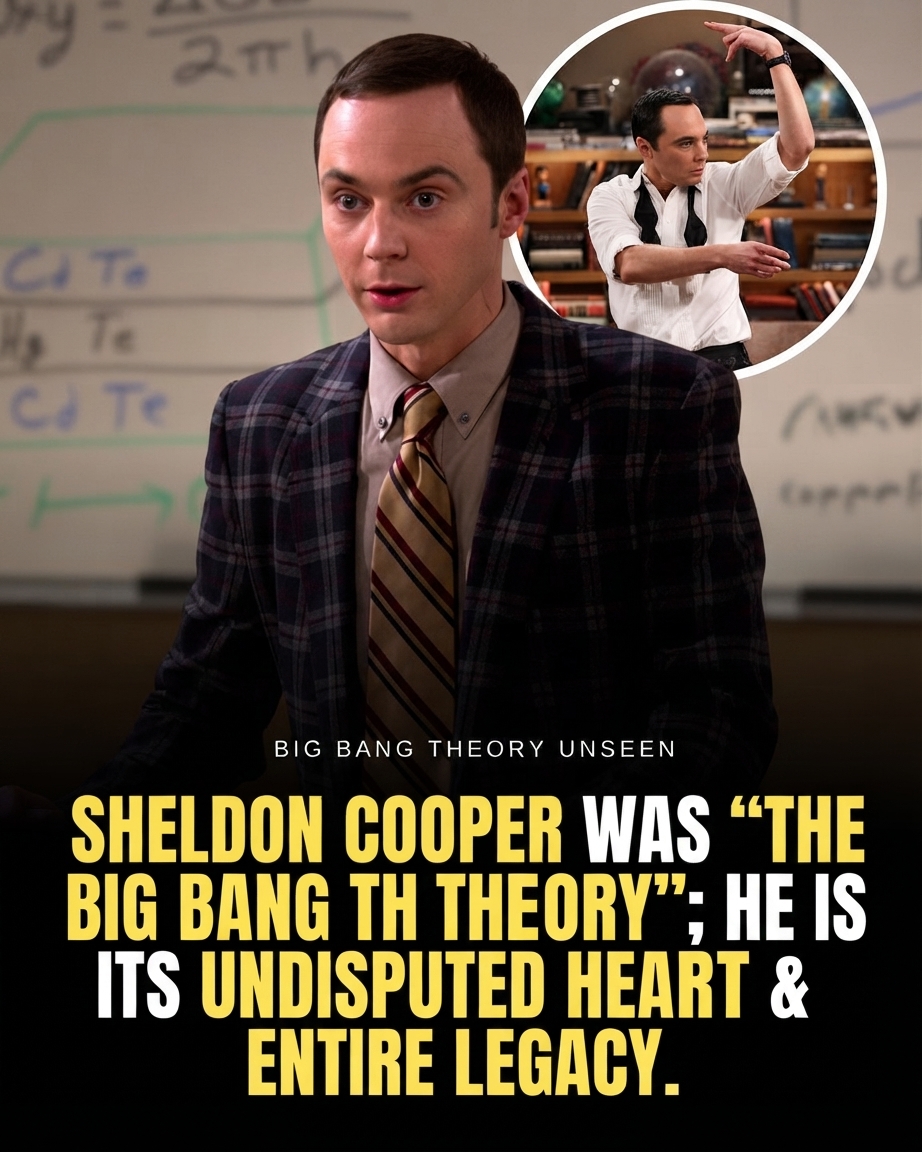
Why Sheldon Cooper Became The Defining Character of The Big Bang Theory
Every successful sitcom eventually produces a character who becomes inseparable from the identity of the show.
For The Big Bang Theory, that character was never really in doubt.
It was Sheldon Cooper.
From his obsession with physics and trains to his legendary “Bazinga,” his carefully guarded spot on the couch, and his inability to understand even the simplest social conventions, Sheldon became far more than another member of the ensemble.
He became the face of the series.
And remarkably, a character who could have been almost impossible to like became one of television's most recognizable sitcom personalities.
Sheldon Was Never Designed Like Everyone Else
When Sheldon first appeared, audiences immediately understood that he was different.
He was exceptionally intelligent, intensely particular, socially awkward, and almost completely convinced that his way of seeing the world was the correct one.
His behavior could be frustrating.
Sometimes it was selfish.
Sometimes it was downright ridiculous.
But there was always something underneath the arrogance that made him fascinating.
Sheldon wasn't simply written as "the smart guy."
He was built around an unusually specific collection of habits, fears, obsessions, rules, and emotional weaknesses.
That specificity became one of the character's greatest strengths.
The Details Made Sheldon Feel Real
One reason Sheldon became so memorable was the extraordinary number of small details attached to him.
His designated place on the couch.
His elaborate knocking ritual.
His reluctance to change his routine.
His obsession with trains.
His relationship agreement.
His difficulty recognizing sarcasm.
His strict expectations surrounding social interaction.
None of these traits would necessarily have been enough to create an iconic sitcom character on their own.
Together, however, they created someone audiences could recognize almost instantly.
You could hear Sheldon knock three times and know exactly who was standing outside the door.
You could hear "Bazinga" and immediately know where it came from.
That is the kind of character recognition very few sitcoms achieve.
Jim Parsons Changed Everything
Much of Sheldon's success came from the actor behind him.
Jim Parsons brought an extraordinary level of precision to the role.
His delivery made even Sheldon's most ridiculous observations sound completely serious.
A simple facial expression could communicate confusion, irritation, superiority, or genuine vulnerability without requiring a long explanation.
That balance was crucial.
Sheldon could insult someone without realizing he had done anything wrong, then moments later reveal a surprisingly sincere emotional side.
Parsons understood how to play both versions of the character.
The arrogance was funny.
The vulnerability was human.
And the combination made Sheldon incredibly difficult to forget.
The Character Who Should Have Been Unlikable
On paper, Sheldon has many qualities that could easily make a sitcom character unbearable.
He can be condescending.
He struggles with empathy.
He expects everyone around him to accommodate his preferences.
He frequently treats his friends' feelings as secondary to his own logic.
Yet audiences continued coming back to him.
Why?
Because the writers gradually revealed that Sheldon's emotional world was much more complicated than his behavior suggested.
His relationship with Amy became especially important in this evolution.
Through Amy, viewers saw Sheldon slowly learn compromise, intimacy, emotional responsibility, and eventually a deeper understanding of the people around him.
His growth never completely erased the Sheldon audiences knew.
It simply added another layer to him.
“Bazinga” Became Bigger Than The Show
Few sitcom catchphrases become part of everyday pop culture.
“Bazinga” did.
The word became so strongly associated with Sheldon that even people unfamiliar with The Big Bang Theory could recognize the reference.
That is one of the clearest signs of a truly iconic television character.
Sheldon didn't just have memorable dialogue.
He created a vocabulary.
His expressions, habits, reactions, and mannerisms became part of the show's cultural identity.
Sheldon Became The Center of a Much Bigger Universe
The importance of Sheldon eventually extended beyond The Big Bang Theory itself.
His childhood became the foundation for Young Sheldon, which transformed the character from a sitcom personality into the center of an entirely new television story.
The prequel explored Sheldon as a child growing up in Texas, allowing audiences to see the experiences and relationships that helped shape the person they already knew.
The fact that the character could successfully support an entire seven-season series demonstrates just how strong his identity had become.
Four Emmys Tell Part of the Story
Jim Parsons received four Primetime Emmy Awards for his performance as Sheldon Cooper.
Those awards represent the industry's recognition of what he accomplished with the character.
But awards are only one measurement.
The larger achievement was cultural.
Sheldon became instantly recognizable.
His voice.
His clothing.
His apartment.
His couch.
His knock.
His catchphrases.
His scientific arrogance.
His friendships.
Even his discomfort with change.
All of it became part of television history.
Why Fans Still Remember Sheldon
The reason Sheldon remains so memorable isn't simply that he was funny.
It is because he was specific.
Many sitcom characters are built around broad personality traits.
Sheldon was built around hundreds of tiny rules.
He had a particular way of sitting.
A particular way of knocking.
A particular way of eating.
A particular way of dealing with illness.
A particular way of organizing his relationships.
A particular way of expressing affection.
Those details gave audiences the feeling that Sheldon existed beyond the immediate joke.
He wasn't simply there to deliver punchlines.
He had his own system for understanding the world.
And watching everyone else collide with that system became one of the show's central sources of comedy.
The Legacy of Sheldon Cooper
After twelve seasons and 279 episodes, The Big Bang Theory became one of television's defining sitcoms.
But when people remember the series years later, Sheldon's image is almost impossible to separate from it.
He represents the show's scientific obsession.
He represents its most recognizable humor.
He represents its most unusual character development.
And, perhaps most importantly, he represents the show's ability to turn an extremely unconventional personality into someone audiences genuinely cared about.
The character who began as an arrogant theoretical physicist eventually became a Nobel Prize winner, husband, friend, and someone capable of openly appreciating the people around him.
That journey took twelve seasons.
And audiences followed every step.
Final Thoughts
Every great sitcom has a character who becomes its signature.
For The Big Bang Theory, that character was Sheldon Cooper.
Jim Parsons didn't simply play Sheldon.
He created a character whose mannerisms, catchphrases, obsessions, and emotional journey became inseparable from the show's identity.
From “Bazinga” to the famous couch spot, from his obsession with trains to his relationship with Amy, Sheldon gave the series a personality unlike anything else on television.



No comments yet