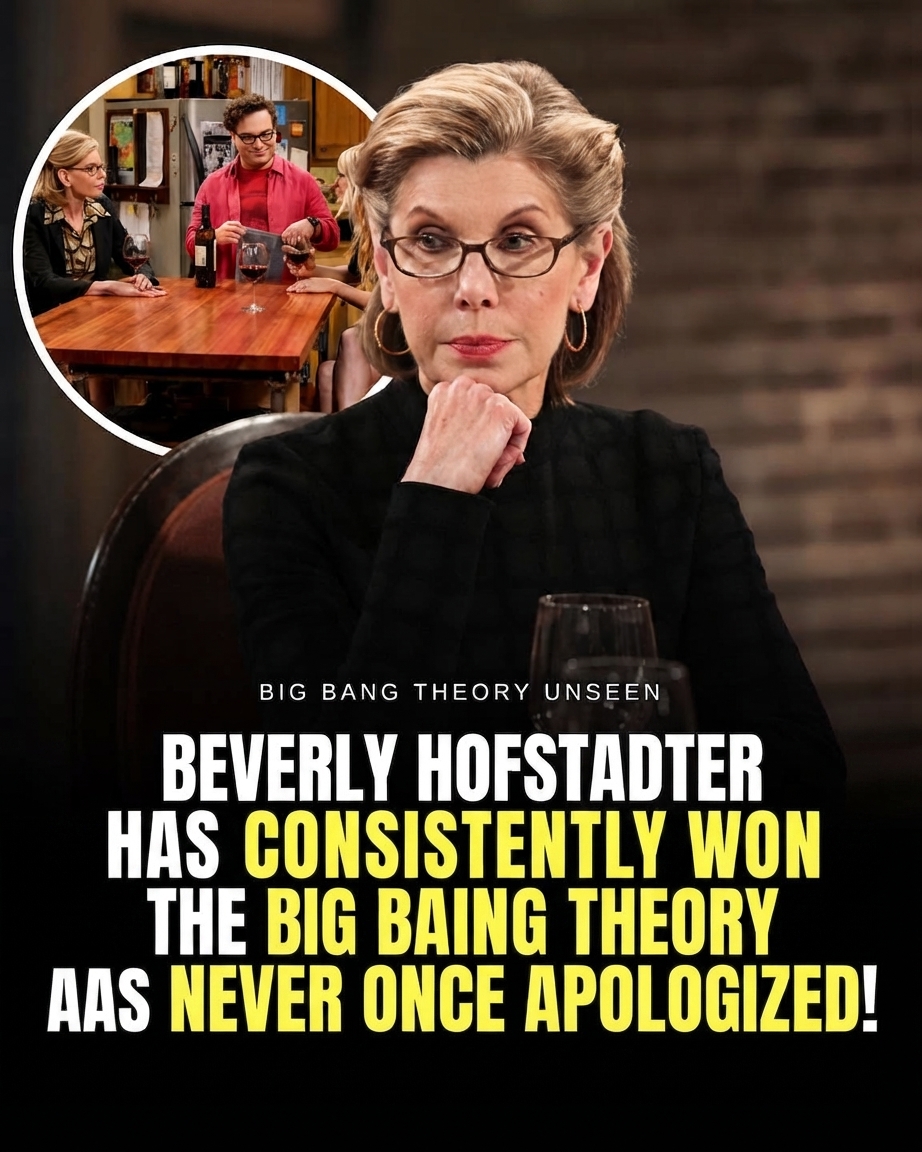
Beverly Hofstadter Wasn't The Big Bang Theory's Villain—She Was Something Much More Uncomfortable
Few recurring characters on The Big Bang Theory generated a reaction quite like Beverly Hofstadter.
She wasn't a villain.
She wasn't violent.
She didn't scream at people or spend her time plotting against anyone.
In fact, Beverly would probably insist that she was an excellent mother.
And that's precisely what made her so unsettling.
Played brilliantly by Christine Baranski, Leonard's mother became one of the show's most memorable recurring characters because her cruelty rarely looked like cruelty to her.
It looked like parenting.
It looked like science.
It looked like perfectly reasonable behavior.
Beverly Saw Leonard as a Psychological Experiment
From her earliest appearances, Beverly treated Leonard very differently from how most parents would treat their children.
She was a renowned psychiatrist and neuroscientist who approached family life with the same analytical mindset she brought to her professional work.
Leonard wasn't simply her son.
He was, at times, something closer to a research subject.
She studied his behavior.
She analyzed his emotional responses.
And she frequently discussed his childhood development with an almost clinical detachment.
For Leonard, that created a childhood in which affection often felt conditional.
Her Lack of Affection Shaped Leonard
One of the most important aspects of Beverly's character is that she didn't necessarily believe she was hurting Leonard.
She believed she was preparing him for life.
Her approach involved deliberately withholding certain forms of affection because she considered emotional distance useful for psychological development.
To Beverly, it was methodology.
To Leonard, it was rejection.
That difference became one of the show's most interesting family dynamics.
Leonard Spent Years Looking for Approval
Once Beverly's influence is understood, many aspects of Leonard's personality become easier to interpret.
Leonard frequently seeks reassurance.
He worries about whether people genuinely love him.
He can become insecure in relationships.
And he often struggles to believe that he is good enough.
His relationship with Penny occasionally exposes exactly how deeply those insecurities run.
Leonard may be an accomplished experimental physicist, but emotionally he is still carrying some of the uncertainty created during his childhood.
And Beverly is never far from the explanation.
The Genius Wasn't Always Warm
What made Beverly especially effective as a character was the contrast between her brilliance and her emotional limitations.
She was intelligent.
Successful.
Accomplished.
And completely comfortable discussing human psychology.
Yet she often struggled to demonstrate the emotional warmth her son needed.
That contradiction produced some of the show's darkest comedy.
Beverly could explain Leonard's behavior with extraordinary precision.
What she couldn't always do was understand how Leonard actually felt about it.
Christine Baranski Made Her Unforgettable
The character could easily have become a caricature.
Instead, Christine Baranski played Beverly with remarkable restraint.
She rarely needed to raise her voice.
She could deliver an absolutely devastating observation with the same calm tone someone else might use to discuss the weather.
That made her comments even funnier—and considerably more uncomfortable.
The smile.
The measured delivery.
The complete confidence.
Beverly never seemed to realize that she had just emotionally destroyed the person standing in front of her.
She Wasn't Written Like a Traditional Sitcom Mother
Most sitcom parents are eventually softened.
Even difficult parents usually receive a sentimental episode explaining their behavior.
Beverly was different.
The show allowed her to remain complicated.
She could genuinely care about Leonard while simultaneously behaving in ways that deeply frustrated him.
She could be proud of her son while criticizing him.
She could offer useful advice while completely misunderstanding the emotional consequences of giving it.
That ambiguity made her feel far more realistic than a conventional sitcom antagonist.
Why Fans Reacted So Strongly
The audience reaction to Beverly wasn't simply about her being mean.
It was about recognition.
Many viewers recognized aspects of her personality from real life.
The parent who believes criticism is motivation.
The parent who considers emotional distance a form of strength.
The parent who measures success while overlooking emotional needs.
The parent who genuinely believes they are helping while leaving lasting wounds behind.
Beverly's behavior was exaggerated for comedy, but the emotional dynamic underneath it was painfully familiar.
Even Penny Struggled to Understand Her
Beverly's relationship with Penny also provided some of the show's funniest contrasts.
Penny is emotionally intuitive in ways Beverly often isn't.
She understands feelings.
She values affection.
She reacts instinctively.
Beverly analyzes.
Putting the two women together created an unusual dynamic because Penny could sometimes see exactly what Leonard needed while Beverly was busy explaining why he needed something else.
Eventually, however, Beverly's relationship with Penny became more complicated—and even surprisingly affectionate in its own strange way.
Beverly Was Never Simply Evil
That's ultimately what makes the character work.
Beverly isn't evil.
She isn't secretly trying to destroy Leonard's happiness.
She genuinely believes her methods made her children stronger.
And that certainty makes her difficult to argue with.
She doesn't see herself as cruel.
She sees herself as rational.
The comedy comes from the enormous gap between Beverly's understanding of herself and everyone else's experience of her.
Final Thoughts
Beverly Hofstadter became one of The Big Bang Theory's most unforgettable recurring characters because she never needed to behave like a traditional villain.
She simply had to be Beverly.
Cold.
Analytical.
Uncomfortably honest.


No comments yet