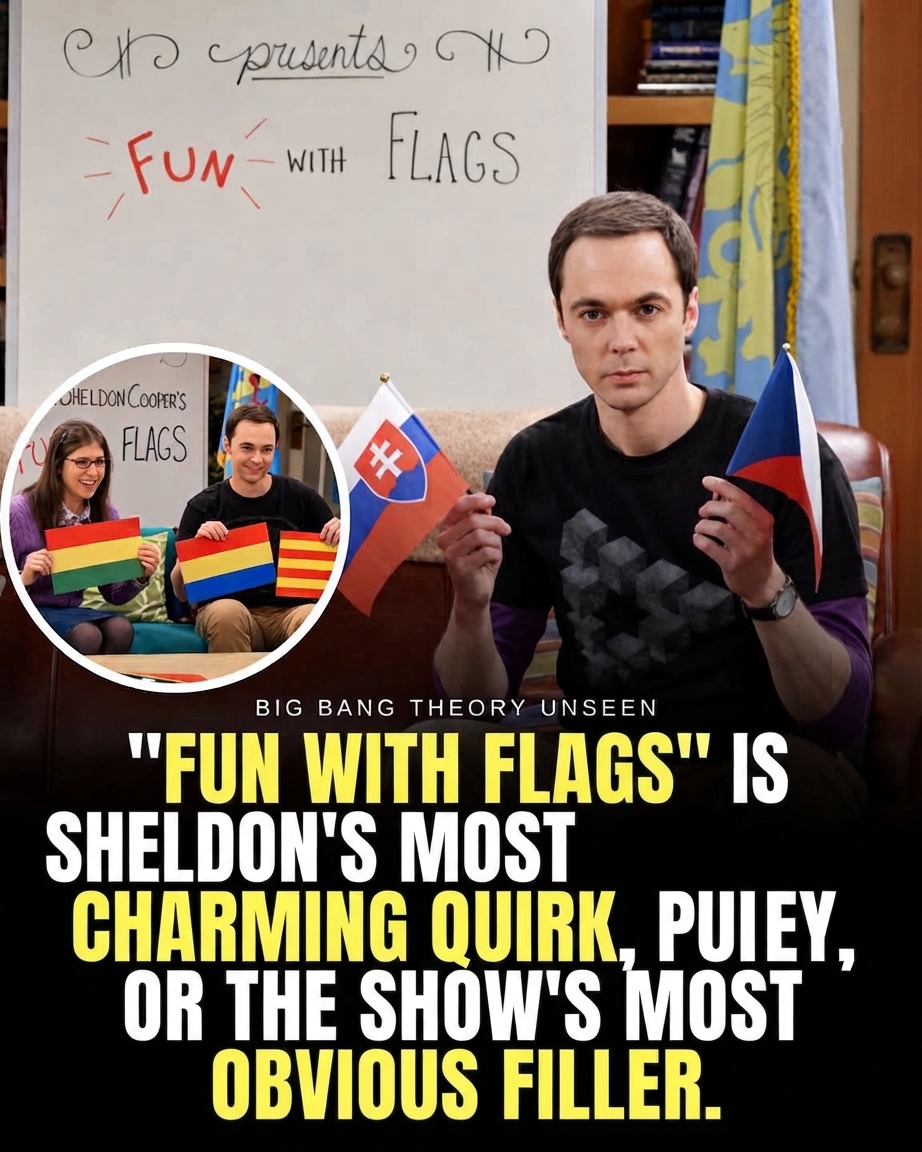
When Sheldon Cooper decided to create a show about flags, it was almost impossible to imagine anything more perfectly Sheldon.
“Sheldon Cooper Presents: Fun with Flags” began as one of The Big Bang Theory's most wonderfully ridiculous running jokes.
A socially awkward theoretical physicist hosting an online program about vexillology?
Of course Sheldon would do that.
And somehow, it worked.
At least at first.
The Perfect Sheldon Cooper Idea
The premise was beautifully simple.
Sheldon hosts a program about flags and treats the subject with extraordinary seriousness.
There is no obvious audience.
There is no obvious reason anyone would want to watch it.
And Sheldon doesn't seem remotely concerned about either problem.
That complete lack of self-awareness was exactly what made the earliest installments so funny.
Sheldon wasn't trying to be ridiculous.
He genuinely believed he was providing an important educational service.
And that made the joke work.
Amy Quickly Became Part of the Formula
Amy Farrah Fowler became one of the most recognizable recurring participants in Fun with Flags.
Her involvement created an additional layer of comedy.
Sheldon could approach the show as though they were hosting an important scientific program, while Amy increasingly found herself trapped inside his bizarre little production.
Their contrasting personalities made the segments especially entertaining.
Sheldon was completely committed.
Amy was considerably more aware of how strange the whole thing looked.
That contrast gave Jim Parsons and Mayim Bialik plenty of opportunities for dry comedy.
Then the Formula Became Predictable
The problem for some viewers was repetition.
Across its appearances, Fun with Flags increasingly followed a familiar structure.
Sheldon hosts.
Someone else gets dragged into the presentation.
Sheldon takes the subject incredibly seriously.
The situation becomes increasingly uncomfortable.
Then the segment ends.
For fans who loved the original joke, that formula remained charming.
For others, it eventually became predictable.
The very consistency that made the gag recognizable also made it easier to anticipate.
A Bigger Problem With Later-Season Running Gags
The criticism goes beyond Fun with Flags itself.
As The Big Bang Theory progressed, some viewers felt the show increasingly relied on established Sheldon trademarks.
His obsession with trains.
His unusual greetings.
His rigid routines.
His fascination with flags.
These were all characteristics that had been funny because they revealed something about Sheldon.
But repeated often enough, they could begin to feel like dependable comic shortcuts.
Whenever a scene needed a familiar Sheldon joke, one of those established behaviors could be brought back.
For some fans, that made the later seasons feel less unpredictable.
Why Other Fans Still Loved It
Of course, Fun with Flags had plenty of defenders.
And their argument makes sense.
The segments captured something fundamental about Sheldon.
He wasn't merely interested in flags.
He was capable of becoming intensely passionate about subjects that almost nobody else cared about.
That was one of his defining characteristics.
The show-within-the-show gave Parsons an opportunity to play Sheldon at his most wonderfully serious and oblivious.
The humor came from watching someone treat an absurdly niche subject as though it were the most important thing happening in the world.
The Amy and Sheldon Dynamic Made It Better
As Sheldon's relationship with Amy developed, Fun with Flags also became another space where their personalities could collide.
Amy understood Sheldon better than almost anyone else.
But understanding Sheldon didn't mean she always enjoyed his behavior.
That distinction made their interactions fun.
She could appreciate his enthusiasm while simultaneously recognizing how ridiculous the situation was.
The flag show therefore became more than a standalone joke.
It became another window into the evolving relationship between Sheldon and Amy.
A Running Gag That Divided Fans
That's ultimately what makes Fun with Flags interesting.
The criticism and the praise can both be true.
If you loved Sheldon's eccentricity, the segments could be hilarious.
If you felt the later seasons relied too heavily on familiar Sheldon routines, the same segments could feel repetitive.
The joke itself didn't necessarily change.
The audience's tolerance for it did.
And that's often the unavoidable fate of a successful running gag.
Final Thoughts
“Fun with Flags” was one of those jokes that could only exist because The Big Bang Theory understood Sheldon Cooper so well.
A world-famous theoretical physicist hosting an absurdly serious online program about flags was ridiculous.
But it was also completely believable for Sheldon.
For some fans, that made the gag endlessly entertaining.
For others, ten appearances were more than enough.
It started as Sheldon being brilliantly ridiculous.

No comments yet