For a sitcom that ran for twelve seasons and 279 episodes, The Big Bang Theory inevitably produced a few episodes that fans liked less than others.
That part isn't particularly controversial.
What is interesting, however, is how difficult it has been for viewers to agree on which episode is actually the worst.
Some sitcoms have one universally accepted disaster — an episode so widely disliked that fans, critics and even the show's own followers can point to it without hesitation.
The Big Bang Theory doesn't really have that.
Instead, its fanbase remains divided.
Different Reddit discussions, fan rankings and critical lists repeatedly return to the same handful of episodes, but there is no single installment that has achieved an undisputed “worst episode” reputation.
And the reasons are surprisingly revealing.
Some episodes are criticized because the characters behave in ways that feel unusually cruel. Others struggle because serious emotional storylines don't sit comfortably alongside the show's comedy. And some simply represent moments when longtime viewers felt the characters had moved too far away from the people they originally loved.
Among the most frequently mentioned contenders are “The Matrimonial Momentum,” “The Itchy Brain Simulation,” and the storylines involving Howard's father.
None is universally condemned.
But each reveals something fascinating about what The Big Bang Theory fans expected from the show.
Why It's So Difficult to Pick a Single Worst Episode
The biggest reason there is no universal answer is that The Big Bang Theory changed considerably over twelve seasons.
The show that premiered in 2007 wasn't the same show that ended in 2019.
Characters changed.
Relationships changed.
The tone changed.
And the balance between science-based comedy, relationship stories and character-driven humor shifted dramatically.
That means different viewers judge different eras by completely different standards.
Some fans prefer the early seasons, when Sheldon, Leonard, Raj and Howard were primarily the focus and the show revolved around their friendship.
Others prefer the later seasons, when Penny, Amy and Bernadette became increasingly important to the ensemble.
Some viewers enjoy the romantic storylines.
Others believe the show was strongest before relationships became such a dominant part of the narrative.
As a result, an episode one viewer considers unbearable can be another viewer's favorite.
That's why the debate continues.
“The Matrimonial Momentum” and the Leonard-Penny Wedding Fallout
One of the most frequently mentioned episodes in discussions about the show's weaker installments is “The Matrimonial Momentum,” the Season 9 premiere.
The episode picks up immediately after Leonard and Penny's Las Vegas wedding.
On paper, this should have been one of the happiest moments in the entire series.
Leonard and Penny had spent years moving toward marriage.
Their relationship had survived breakups, misunderstandings, competing expectations and years of emotional uncertainty.
Finally, they were married.
Except there was a problem.
Leonard had kissed another woman during a trip to the North Sea.
He hadn't told Penny before the wedding.
And the revelation complicated what should have been a straightforward celebration.
The Problem With the Episode's Tone
The criticism isn't necessarily that the storyline itself was unrealistic.
The problem for many viewers was tonal.
The episode was trying to balance a major relationship crisis with the lighthearted comedy audiences expected from The Big Bang Theory.
That isn't an easy combination.
Leonard's confession has genuine emotional consequences.
Penny has every reason to be upset.
The audience has invested years in their relationship.
But the show still needs to function as a sitcom.
For some viewers, the result feels uncomfortable rather than funny.
The episode asks audiences to take Leonard and Penny's marriage seriously while simultaneously expecting them to laugh at the surrounding situations.
That tonal tension is one reason the episode continues to appear in discussions about the show's weakest moments.
Leonard and Penny Had Already Been Through So Much
Another reason the episode frustrated some fans is that it arrived after years of watching Leonard and Penny develop.
Their relationship wasn't new.
It was one of the show's central emotional storylines.
Viewers had watched Leonard pursue Penny.
They had watched Penny gradually realize that her feelings for him were deeper than she initially admitted.
They had watched them date, break up, reunite and eventually become engaged.
By the time they reached the wedding, many fans wanted the payoff.
Instead, the show immediately introduced another major obstacle.
For some viewers, that made the storyline feel unnecessarily repetitive.
For others, however, it was simply an honest complication that made the characters feel human.
And that disagreement is precisely why “The Matrimonial Momentum” remains controversial rather than universally hated.
“The Itchy Brain Simulation” May Be the Most Frustrating Contender
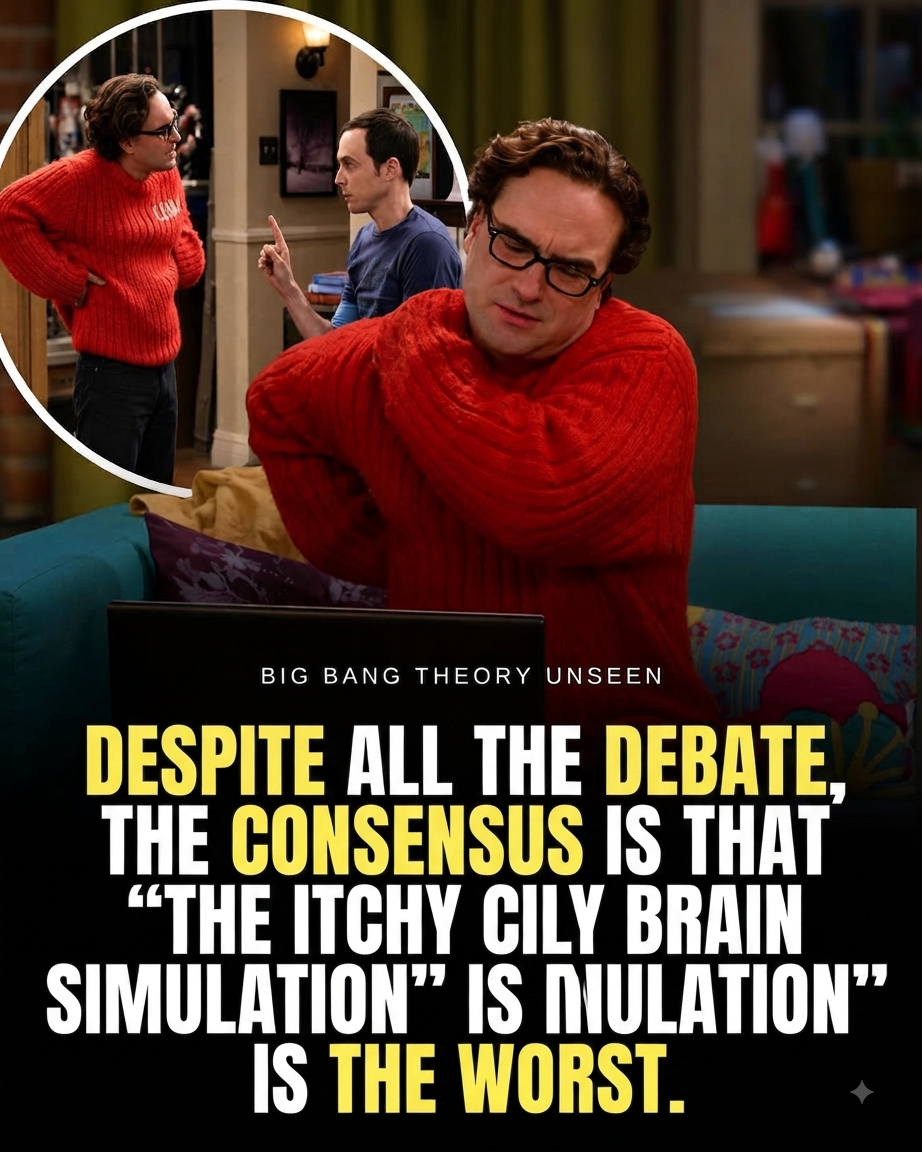
If there is one episode that repeatedly generates unusually strong criticism, it is “The Itchy Brain Simulation.”
The Season 7 episode revolves around Leonard discovering that he failed to return an old DVD.
What follows is classic Sheldon logic — at least initially.
Sheldon decides Leonard needs to be punished.
His solution?
Leonard must wear an uncomfortable, itchy sweater as a form of “penance.”
The premise is deliberately ridiculous.
But the episode becomes increasingly uncomfortable as Sheldon refuses to let the situation go.
Sheldon Turns a Small Mistake Into Torture
Leonard's mistake is relatively minor.
He forgot to return a DVD.
That's it.
But Sheldon transforms the situation into an elaborate punishment exercise.
Leonard is forced to wear the sweater.
He becomes increasingly uncomfortable.
And Sheldon insists that Leonard complete the punishment because he believes there is a larger moral lesson involved.
For some fans, this is where the episode crosses a line.
Sheldon had always been selfish, socially unaware and difficult.
Those traits were central to his comedy.
But the character's flaws were usually balanced by innocence, vulnerability or an inability to understand the consequences of his actions.
In “The Itchy Brain Simulation,” some viewers felt that balance disappeared.
The Twist Makes Everything Worse
The episode's ending is what makes the controversy particularly interesting.
Sheldon had already quietly returned the DVD.
The entire ordeal wasn't necessary.
He had engineered Leonard's punishment as a lesson.
That changes the audience's understanding of what happened.
Sheldon wasn't simply enforcing a strange personal rule.
He knowingly allowed Leonard to suffer because he believed the experience would teach him something.
That is a considerably darker version of Sheldon.
One critical interpretation of the episode argued that Sheldon is lovable precisely because his inability to change is genuine — but that this story risks suggesting that his behavior is instead deliberate manipulation.
That distinction matters.
A character can be selfish without being cruel.
A character can be socially unaware without being malicious.
And many fans felt the episode blurred that line.
Was Sheldon Actually Becoming Too Mean?
This is one of the most persistent debates surrounding the later characterization of Sheldon.
Early Sheldon could be infuriating.
He could insult people.
He could ignore social boundaries.
He could demand that everyone follow his rules.
But there was usually a sense that he genuinely didn't understand why people were upset.
That made him funny.
His behavior came from an almost childlike certainty that his interpretation of the world was correct.
As the series progressed, however, Sheldon became increasingly aware of other people's feelings.
That was part of his character development.
But awareness creates a new problem.
Once Sheldon understands that something hurts Leonard and deliberately continues doing it, the audience evaluates his behavior differently.
That's why “The Itchy Brain Simulation” remains such a divisive episode.
It's not simply about a sweater.
It's about whether Sheldon had crossed the line between socially oblivious and intentionally cruel.
Howard's Father Storylines Are Different
Another recurring source of discomfort involves Howard Wolowitz's father.
Unlike the other contenders, these episodes aren't necessarily criticized because they are badly written.
Instead, fans often struggle with the emotional weight of the storyline.
Howard's father abandoned him when he was a child.
For years, Howard carried that absence as one of the deepest unresolved wounds in his life.
The show occasionally explored the subject through comedy, but eventually introduced a letter from Howard's father that offered answers without completely resolving the mystery.
The Emotional Weight Was Real
The father storyline gave Simon Helberg some of Howard's strongest dramatic material.
Howard wasn't simply the immature womanizer audiences had met during the early seasons.
He was someone dealing with abandonment.
He wanted answers.
He wanted to understand why his father left.
And he wanted some kind of closure.
Those are serious emotional themes.
The problem is that The Big Bang Theory remained a sitcom.
That created an unusual tonal challenge.
One moment the audience could be laughing at Howard and Raj.
The next, they were dealing with the emotional consequences of a parent abandoning his child.
Some viewers appreciated the depth.
Others felt the subject matter didn't fit comfortably into the show's comedic structure.
Why Some Fans Still Appreciate These Episodes
It's important to remember that criticism doesn't automatically mean an episode failed.
In fact, some of the episodes most frequently criticized are also defended by passionate fans.
“The Itchy Brain Simulation,” for example, can be viewed as an intentionally exaggerated demonstration of Sheldon's inability to let go of a perceived injustice.
“The Matrimonial Momentum” can be interpreted as a realistic complication rather than unnecessary drama.
And Howard's father storyline gave the character emotional depth that the earlier seasons rarely explored.
In other words, the very qualities that make these episodes controversial are also the qualities that make them interesting.
The Big Bang Theory Was Never a Perfect Show
After 279 episodes, expecting every episode to work equally well would be unrealistic.
Even the most successful sitcoms have experiments that don't land.
Some jokes age differently.
Some character decisions become controversial.
Some storylines feel better in retrospect than they did when they originally aired.
And some episodes simply don't match what individual viewers wanted from the characters.
That's normal for a show with such a long run.
What makes The Big Bang Theory interesting is that its imperfections are still being debated.
Years after the finale, fans continue to discuss whether Sheldon became too cruel, whether Leonard and Penny's relationship was handled correctly, and whether the Howard storyline belonged in the show's comedic world.
That level of discussion is itself evidence of how invested audiences became in these characters.
The “Worst Episode” Depends on What You Value
Ultimately, there may never be a definitive answer.
If you value the early version of Sheldon, “The Itchy Brain Simulation” may feel like a betrayal of the character.
If you wanted Leonard and Penny's wedding to be a straightforward emotional payoff, “The Matrimonial Momentum” may be frustrating.
If you prefer The Big Bang Theory as pure comfort comedy, Howard's father storyline may feel too emotionally heavy.
But if you value character development and emotional complexity, you might appreciate precisely those elements.
That's why the debate refuses to disappear.
What Fans Are Really Debating
When fans argue about the worst episode of The Big Bang Theory, they're rarely arguing only about an individual episode.
They're arguing about what they believe the show should have been.
Should Sheldon remain fundamentally unchanged?
Should Leonard and Penny's relationship have been more stable?
Should the show have avoided heavier family trauma?
Should comedy take priority over emotional realism?
Those are much bigger questions than simply asking which episode had the weakest jokes.
And that's why the debate remains surprisingly passionate.
Final Thoughts
There may never be one universally accepted “worst” episode of The Big Bang Theory.
“The Matrimonial Momentum” remains controversial because it placed a serious relationship problem immediately after Leonard and Penny's long-awaited wedding.
“The Itchy Brain Simulation” continues to frustrate fans because it pushed Sheldon into behavior that many felt was more deliberately cruel than socially oblivious.
And Howard's father storylines remain divisive because they introduced genuinely painful family trauma into a sitcom built primarily around comfort and comedy.
None of these episodes completely destroys the show.
None is universally hated.
And that's ultimately what makes the debate so interesting.
A show doesn't survive for twelve seasons and 279 episodes because every story is perfect.
It survives because audiences care enough about the characters to argue about them.
The Big Bang Theory fandom may never agree on its worst episode.
But the fact that fans are still debating the question years after the finale says something important.
The characters mattered.
The stories mattered.
And even the episodes that didn't work for everyone became part of a much larger conversation about a sitcom that audiences simply weren't ready to stop talking about.
No comments yet