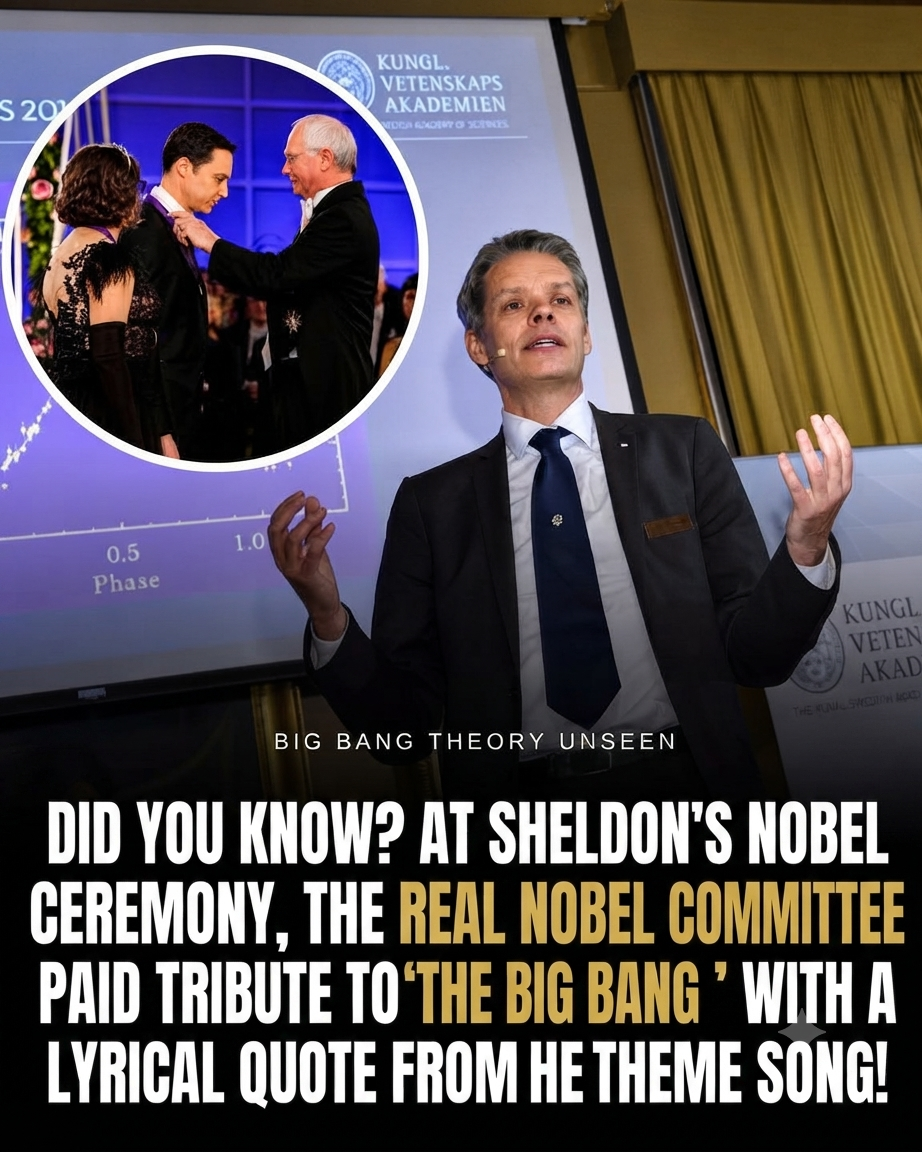
The Big Bang Theory concluded its 12-season run in May 2019 with one of the most satisfying endings in sitcom history. After years of dedication to science, Sheldon Cooper and Amy Farrah Fowler finally achieved their lifelong dream by winning the Nobel Prize in Physics.
Few fans imagined that only a few months later, the real Nobel Prize ceremony would acknowledge the series in a remarkable tribute.
A Surprise Reference in Stockholm
During the announcement of the 2019 Nobel Prize in Physics in Stockholm, academy member Ulf Danielsson opened the ceremony with a line instantly familiar to millions of television viewers.
He quoted the opening lyrics of The Big Bang Theory theme song:
"Our whole universe was in a hot, dense state..."
For fans of the sitcom, it was a delightful and unexpected moment that connected one of television's most famous science-themed comedies with one of the world's most prestigious scientific institutions.
Why the Nobel Committee Did It
The reference wasn't made as a joke.
Göran K. Hansson, Secretary General of the Royal Swedish Academy of Sciences at the time, explained that The Big Bang Theory had done something genuinely meaningful for public engagement with science.
He praised the sitcom for bringing scientific ideas into homes around the world and helping introduce millions of viewers to scientific concepts through humor and storytelling.
Because of that cultural impact, he said, opening the ceremony with the show's famous theme song felt entirely appropriate.
Hansson also included a playful message aimed directly at the sitcom's fictional Nobel Prize winners, joking that he hoped Sheldon and Amy were "not too disappointed today."
Fiction Inspiring Reality
The timing made the tribute even more remarkable.
Only months earlier, audiences had watched Sheldon and Amy receive the Nobel Prize during the emotional series finale.
Then, in real life, the Nobel committee referenced the very show that had imagined the moment.
It created a rare crossover between fiction and reality that few television series ever experience.
A Lasting Cultural Legacy
The Big Bang Theory was always more than a traditional sitcom.
Across 12 seasons, it introduced mainstream audiences to topics ranging from quantum physics and astronomy to engineering and mathematics while celebrating curiosity and scientific discovery.
The Nobel committee's tribute reflected just how influential the series had become beyond entertainment.
It wasn't simply one of television's biggest comedies—it had become part of the broader conversation about science and popular culture.
No comments yet