For twelve seasons and 279 episodes, The Big Bang Theory gave audiences an enormous amount to watch: scientific jokes, relationship drama, apartment arguments, elaborate schemes, awkward social encounters, and some of the most recognizable characters in modern sitcom history.
But there was another tradition hiding in virtually every episode.
It appeared after the story was over, after the final joke had landed, and after the credits had begun to roll. For only a brief moment, a small block of text would appear on screen—so quickly that most viewers never had a realistic chance of reading it.
These were Chuck Lorre's famous vanity cards.
To casual viewers, they were easy to miss. To anyone who knew where to look, however, they became one of television's most unusual recurring traditions.
And unlike most post-credit material, these cards usually had very little to do with the episode that had just aired.
The Message Hidden After the Credits
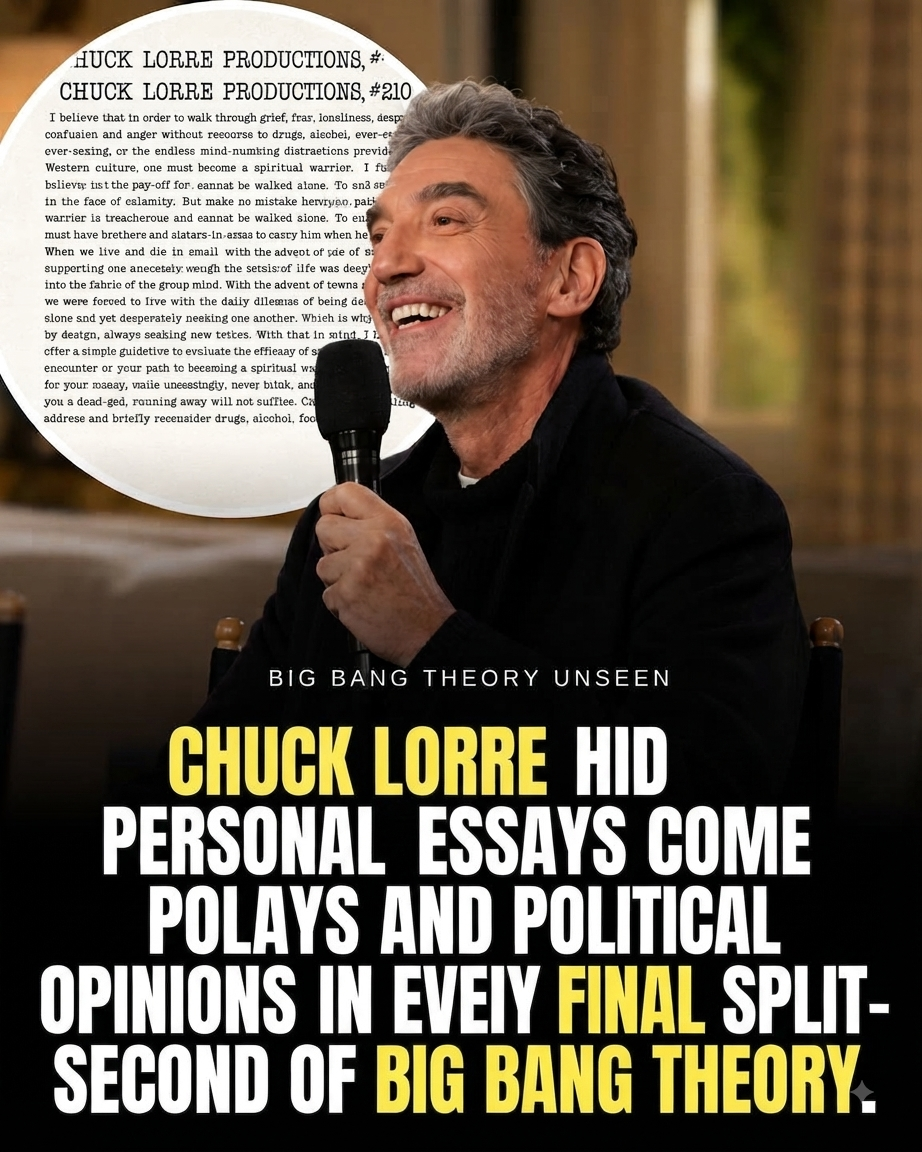
Chuck Lorre's vanity cards are essentially miniature essays that appear at the end of his television productions.
They can contain jokes, personal observations, philosophical thoughts, political commentary, frustrations, confessions, or deliberately strange reflections on everyday life.
The format is deceptively simple.
A viewer watches an episode of The Big Bang Theory. The story ends. The credits begin. Then, for an extremely short period, a small white card containing dense black text appears against a dark background.
Then it disappears.
Unless the viewer pauses the recording, the message is almost impossible to read comfortably.
That was never really the point, though.
The cards became Lorre's private little corner of television—a place where the creator could step outside the fictional world he had just spent half an hour constructing and speak directly, and sometimes cryptically, to whoever happened to be watching.
A Tradition That Began Long Before The Big Bang Theory
The vanity cards were not created specifically for The Big Bang Theory.
Lorre had already established the tradition years earlier, beginning with Grace Under Fire. The practice continued through many of his later productions, eventually becoming almost a signature of his television work.
By the time The Big Bang Theory became one of the biggest sitcoms in the world, audiences familiar with Lorre's shows already knew to look for them.
But the enormous popularity of The Big Bang Theory gave the cards a much larger audience.
Millions of people were watching the sitcom every week, yet only a fraction of those viewers were actually reading what appeared after the credits.
That created an amusing contradiction.
One of television's most widely watched sitcoms was ending each episode with a message that was deliberately difficult to consume.
They Were Never Really About The Episode
Perhaps the most interesting thing about the vanity cards is how completely separate they could be from the story.
An episode might revolve around Sheldon having a disagreement with Amy, Howard struggling with fatherhood, Leonard and Penny arguing about their future, or Raj dealing with another romantic disaster.
Then the episode would end.
And Lorre might suddenly use the vanity card to discuss aging, politics, personal frustration, mortality, relationships, or something completely ridiculous.
There was no obligation for the card to explain the episode.
It didn't need to provide a moral.
It wasn't necessarily a behind-the-scenes note.
It was simply Lorre's space.
That independence is part of what made the tradition so unusual.
Television normally asks viewers to stay inside the fictional world. Lorre's cards occasionally reminded them that there was a real person behind the production—and that person had his own thoughts about the world outside the sitcom.
The Cards Became Increasingly Personal
Over the years, Lorre used the cards for remarkably personal observations.
Some were deliberately provocative. Others were self-deprecating. Some were philosophical, while others were little more than elaborate jokes.
He wrote about aging, relationships, sexuality, politics, fame, Hollywood, mortality, and his own experiences.
The subjects could shift dramatically from one card to another.
That unpredictability became part of the appeal.
A viewer never quite knew what would appear next.
The cards also became a kind of running record of Lorre's own life and changing perspective. As the years passed, the accumulated collection documented different periods of his career and personal thinking.
In that sense, the vanity cards became something more than promotional material or an eccentric production habit.
They became an archive.
CBS Didn't Always Approve
The freedom of the vanity cards occasionally created problems.
Because Lorre used the cards to express opinions that were not always aligned with network sensibilities, CBS sometimes objected to particular messages.
And that created an unusual situation.
A sitcom creator had essentially carved out a tiny piece of network television for personal writing—and the network did not always agree with what he wanted to put there.
Some cards were reportedly censored or withheld.
But Lorre sometimes found another way to make his point.
Rather than rewriting a card to satisfy the network, he could simply acknowledge that it had been rejected.
The full version could then appear online.
That approach created a strange new relationship between television censorship and the internet.
The card that viewers weren't allowed to see on television could still exist elsewhere, allowing curious fans to find the uncensored version themselves.
The Internet Became Part of the Tradition
This is where the vanity cards became particularly clever.
Television could control what appeared on the broadcast.
The internet was considerably harder to contain.
When a card was removed or altered, its disappearance could become part of the story itself.
Fans knew that if a particular message didn't appear, there might be a reason.
Lorre could then direct readers toward the uncensored version online.
In effect, censorship sometimes gave the cards more attention than they would have received otherwise.
A message that might have been ignored suddenly became something viewers actively wanted to find.
The forbidden card became the interesting card.
Why Were the Cards Shown for Such a Short Time?
One of the enduring mysteries for casual viewers is why the cards were displayed so briefly.
The answer is partly practical and partly intentional.
Television schedules are tightly controlled. Every second matters. Networks have advertising commitments, programming schedules, and timing requirements.
But the cards also developed their own identity because they were not designed to function like conventional television segments.
They were almost secret messages.
If you wanted to read one, you had to pay attention.
Eventually, viewers developed their own methods: pausing recordings, rewinding broadcasts, taking screenshots, or searching online for transcriptions.
What was once practically unreadable became searchable fan material.
The Big Bang Theory Was the Perfect Home for the Tradition
There is something particularly appropriate about the vanity cards appearing at the end of The Big Bang Theory.
The sitcom itself was obsessed with tiny details.
Its characters noticed things most people ignored. Sheldon could become fixated on wording, scientific inaccuracies, schedules, routines, apartment arrangements, and seemingly insignificant inconsistencies.
The vanity cards operated on a similar principle.
They rewarded viewers who were paying attention.
A person could watch an episode casually and never know the card existed.
Another viewer could pause the screen and discover an entirely separate piece of writing waiting for them.
In a show built around characters who constantly looked beneath the surface of ordinary things, that was an oddly fitting tradition.
More Than a Production Signature
By the time The Big Bang Theory ended in 2019, the vanity cards had become so closely associated with Lorre's work that they were recognizable as a signature.
They represented a rare creative privilege in mainstream television: the ability for a show creator to communicate something personal without turning it into dialogue, a subplot, an interview, or a promotional campaign.
The cards were not required for the sitcom to function.
They didn't advance the story.
They didn't develop Sheldon, Leonard, Penny, Howard, Raj, Amy, or Bernadette.
And yet they became part of the experience.
They were the final little surprise after the actual episode had finished.
The Tradition Also Says Something About Television
The vanity cards are interesting because they reveal how much television exists beyond what audiences are normally expected to notice.
Viewers usually focus on the actors, characters, dialogue, sets, music, jokes, and storylines.
But television is also filled with tiny creative decisions.
A prop sitting in the background.
A number on an apartment door.
A photograph on a shelf.
A line hidden in the credits.
Or, in Lorre's case, a paragraph of text that disappears before most people can finish reading it.
These details create a second layer of television—one designed almost exclusively for obsessive viewers.
The Big Bang Theory had plenty of Easter eggs, but the vanity cards were different.
They weren't hidden inside the fictional universe.
They came from the person who created it.
A Six-Hundred-Plus-Card Time Capsule
As Lorre's collection grew into hundreds of cards, the individual messages began to form something much larger.
Taken together, they became a record of a television creator's changing interests, frustrations, fears, opinions, and sense of humor.
Some cards aged better than others.
Some became historical curiosities.
Others remain funny because the subjects they address are timeless.
But the sheer volume is what makes the collection fascinating.
One card might be forgotten almost immediately.
Hundreds of them together become a portrait.
And that's perhaps the most unexpected legacy of the tradition.
What began as a quirky post-credit feature eventually became a massive collection of personal writing attached to decades of American television.
The Most Big Bang Theory Thing About Them
There's an amusing irony to the whole tradition.
The Big Bang Theory was a show about people who loved information.
Its characters collected facts, memorized trivia, debated obscure subjects, corrected one another, and became intensely interested in details that ordinary people would overlook.
And at the end of every episode, the show quietly offered viewers another piece of information.
Most people ignored it.
The people who cared enough to stop, pause, read, and investigate discovered an entirely different layer of the production.
In a way, the vanity cards were the ultimate reward for the kind of viewer The Big Bang Theory itself celebrated.
The curious one.
The obsessive one.
The person who couldn't simply let a mystery go.
.

No comments yet