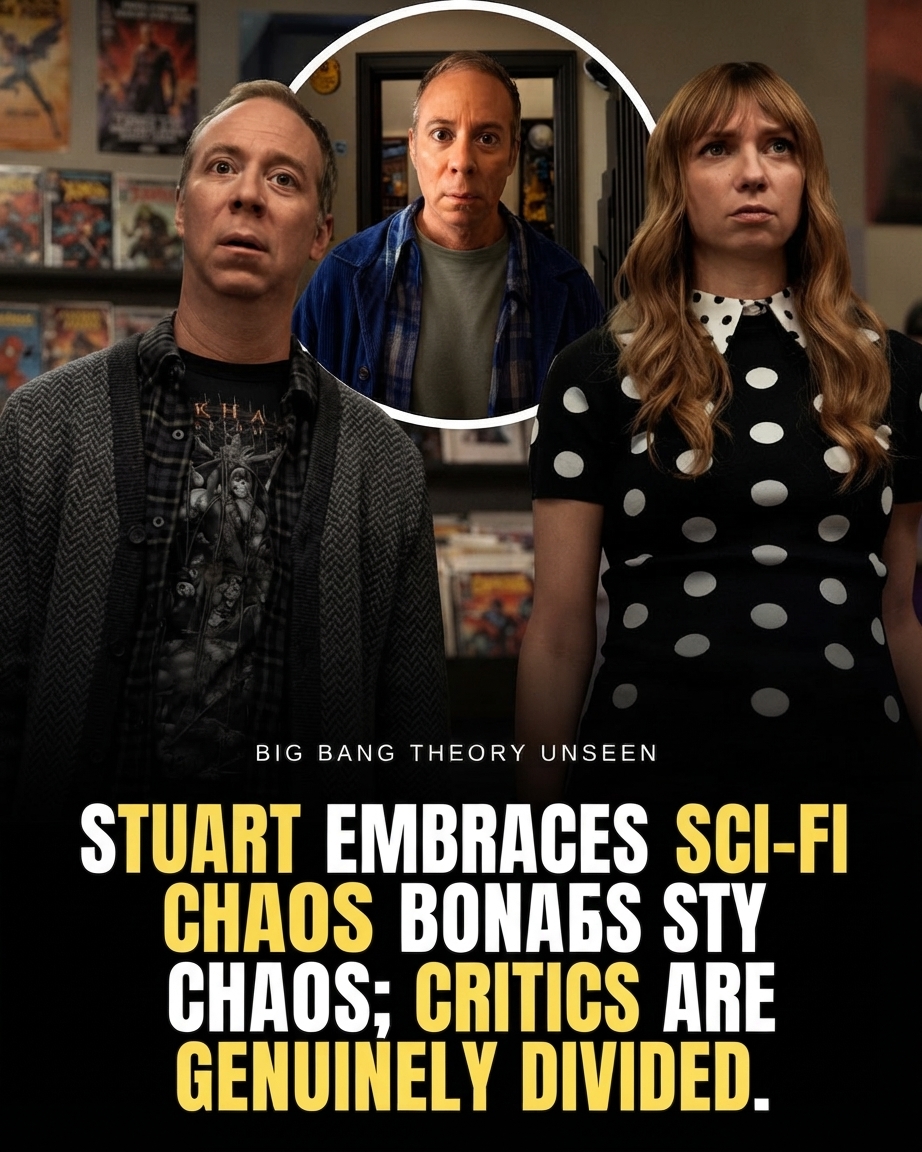
Stuart Fails to Save the Universe Has Big Bang Theory Fans Completely Divided
The Big Bang Theory universe has entered unfamiliar territory.
After twelve seasons of multi-camera sitcom comedy, familiar apartment sets and a laugh track, Stuart Fails to Save the Universe takes the franchise somewhere dramatically different.
Instead of returning to the comfortable world of Apartment 4A, the new series throws Stuart Bloom and several overlooked characters into a chaotic multiverse adventure.
And viewers aren't entirely sure what to make of it.
This Isn't the Big Bang Theory Fans Remember
The biggest change is immediately obvious.
Stuart Fails to Save the Universe abandons the traditional multi-camera sitcom format and embraces single-camera science-fiction comedy.
There is no laugh track telling viewers when to laugh.
There is no familiar apartment-centered structure.
And there is no guarantee that the characters fans recognize will behave anything like their original versions.
The result is something that feels less like another traditional Big Bang Theory sitcom and more like a genre experiment built inside the franchise.
Stuart Finally Gets the Spotlight
At the centre of the chaos is Stuart Bloom.
For years, Stuart was one of the franchise's most overlooked characters.
He owned the comic book store.
He knew the main characters.
He was constantly surrounded by their adventures.
But he rarely received the same attention as Sheldon, Leonard, Penny, Howard or Raj.
The new series changes that.
Stuart becomes the unlikely hero of a multiverse crisis that is largely his own fault.
And naturally, he is probably the least qualified person imaginable to fix it.
The Supporting Characters Make the Difference
Stuart isn't facing the multiverse alone.
Denise, Bert and an alternate-universe version of Kripke become part of his strange new team.
That combination is one of the show's most interesting ideas.
Rather than simply creating another Sheldon-centered continuation, the series takes characters who spent years in the background and gives them an opportunity to carry the story themselves.
It's a risky choice.
But it's also what makes the spinoff feel different.
Critics Can't Agree on the Show
The critical response has been unusually mixed.
Some reviewers have criticized the series for feeling messy and inconsistent, while others have praised its willingness to experiment.
The disagreement is particularly interesting because most viewers seem to recognize that the show is attempting something ambitious.
The question isn't whether it is different.
It clearly is.
The question is whether that difference makes it better.
Kevin Sussman Has Become a Major Highlight
One area where the response has been considerably more consistent is Kevin Sussman's performance.
After years of playing Stuart as the awkward comic-book-store owner, Sussman gets considerably more room to explore the character.
The result gives Stuart a different emotional dimension.
He's still awkward.
He's still frequently overwhelmed.
But now he's responsible for something much bigger than keeping a comic book store alive.
He's trying to save the universe.
And he's doing it in the most Stuart way possible.
The Multiverse Opens Endless Possibilities
The show's biggest creative advantage is also its biggest gamble.
Once the multiverse becomes part of the story, almost anything is possible.
Characters can return in completely different forms.
Familiar locations can be transformed.
The rules of the original sitcom no longer necessarily apply.
That gives the writers enormous freedom.
But it also means longtime fans may encounter versions of their favorite characters that feel almost completely unfamiliar.
For some viewers, that's exciting.
For others, it's unsettling.
Why the Divided Reaction Makes Sense
After twelve seasons, The Big Bang Theory developed a very specific identity.
Fans knew what they were getting.
A group of friends.
A familiar apartment.
Scientific arguments.
Relationship drama.
A live audience.
And plenty of recurring jokes.
Stuart Fails to Save the Universe deliberately breaks that formula.
It's darker.
Stranger.
More visually ambitious.
And far less predictable.
That means viewers looking for another traditional Big Bang Theory sitcom may be disappointed.
But viewers willing to treat it as a completely different kind of story may find something surprisingly entertaining.
Final Thoughts
The Big Bang Theory universe has never been this strange before.
And for a franchise built around people who spent years arguing about the possibilities of the universe...
Perhaps the strangest universe was always the most appropriate one. 🌌
No comments yet