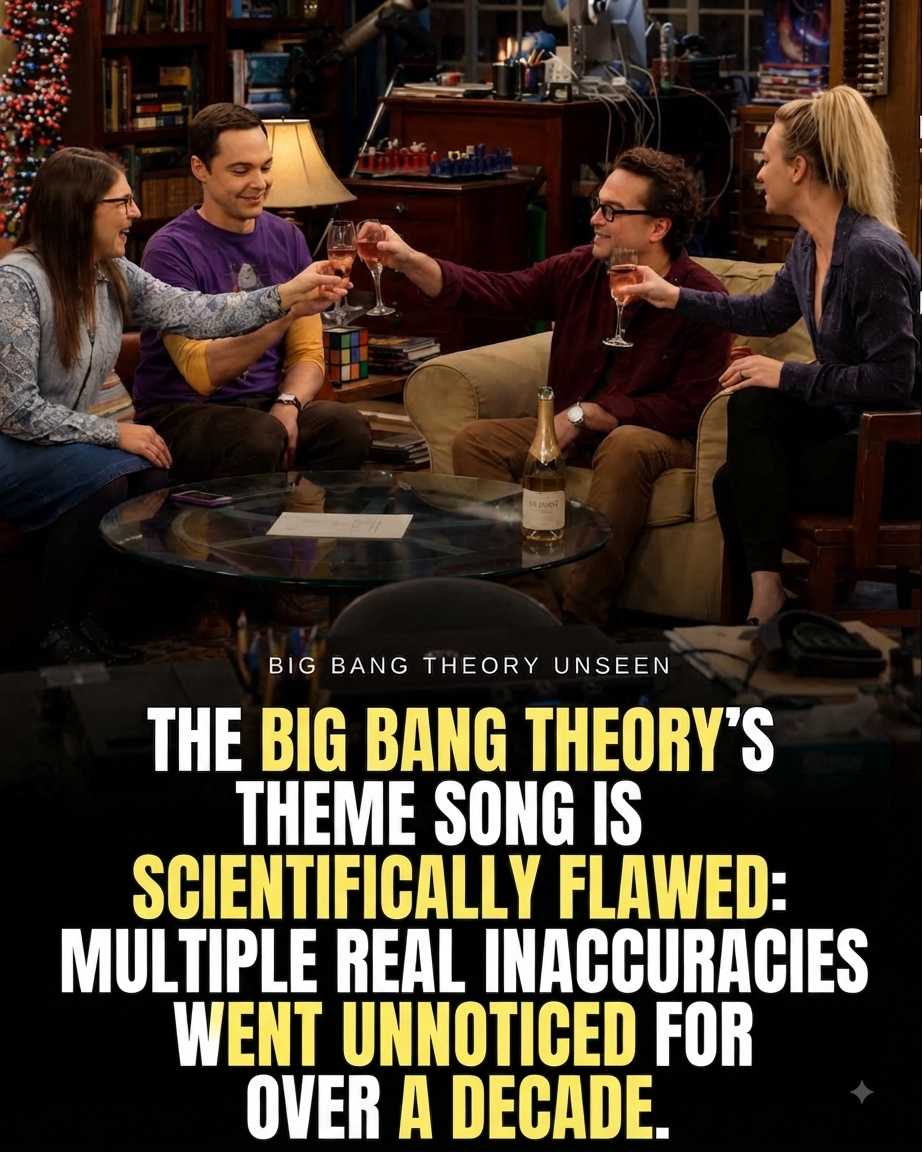
For a television series built around scientists who could spend an entire conversation arguing over the smallest factual detail, The Big Bang Theory contained a surprisingly ironic flaw right in its opening sequence.
The show's iconic theme song, performed by Barenaked Ladies, became one of the most recognizable television themes of the 21st century. In less than 30 seconds, it attempted to compress the entire history of the universe into a rapid-fire journey through evolution, civilization, science, and human achievement.
It was catchy. It was clever. It was fast.
It was also not entirely accurate.
Some of the lyrics simplify scientific history so dramatically that Sheldon Cooper would probably have demanded a rewrite. Others compress thousands or even millions of years of human development into a few seconds, while one visual detail hidden in the opening credits appears to contain an outright typographical error.
The irony is almost perfect.
A show whose characters were famous for correcting one another over scientific inaccuracies spent twelve seasons opening with a song that contained several questionable claims of its own.
A Theme Song Designed to Tell the Entire History of Humanity
When The Big Bang Theory premiered in 2007, its opening sequence immediately established the show's central identity.
The montage races through the history of existence, moving from the formation of the universe through the development of Earth, prehistoric life, human civilization, scientific discoveries, and the modern world.
The sequence works because it is deliberately overwhelming.
There is no time to stop and analyze every image. The viewer is expected to experience the entire history of existence as a fast-moving visual joke before the show's title appears.
That speed also makes the inaccuracies remarkably easy to miss.
The lyrics were never intended to function as a scientific textbook. They were written to be entertaining, memorable, and broad enough to summarize billions of years of history in seconds.
But when you slow everything down and examine the claims individually, some of the shortcuts become surprisingly noticeable.
And considering the personalities of Sheldon, Leonard, Amy, and the rest of the gang, the mistakes become even funnier.
“Neanderthals Developed Tools” Isn't Quite Right
One of the most obvious scientific simplifications appears in the lyric:
"Neanderthals developed tools."
The problem is the timeline.
Tool use did not begin with Neanderthals.
Stone-tool technology existed millions of years before Neanderthals appeared. The archaeological record contains evidence of toolmaking and tool use among early hominins long before the Neanderthals became a distinct population.
Some of the earliest known stone tools date back roughly 3.3 million years, while the more famous Oldowan technology emerged around 2.6 million years ago.
Neanderthals, of course, were highly capable toolmakers themselves. They developed sophisticated technologies and used a variety of tools for hunting, processing materials, and surviving in challenging environments.
So the lyric isn't completely nonsensical.
It's simply an enormous oversimplification.
The distinction matters because The Big Bang Theory spent twelve seasons teaching audiences that scientific precision matters.
Sheldon would almost certainly have objected.
He might have interrupted the song halfway through, demanded a correction, and then explained the evolutionary timeline in considerably more detail than anyone wanted to hear.
The Pyramid and Great Wall Timeline Is Also Compressed
Another amusing example appears when the song celebrates humanity's monumental achievements:
"We built a wall! We built the pyramids!"
The lyric creates the impression of a straightforward sequence of human construction achievements.
But history is considerably messier.
The Great Pyramid of Giza was constructed during Egypt's Fourth Dynasty, generally dated to around the 26th century BCE. The monument was built roughly 4,500 years ago and remains one of the most extraordinary engineering accomplishments of the ancient world.
The Great Wall of China, meanwhile, was not built as one continuous structure at one particular moment.
Different defensive walls were constructed and connected over many centuries, beginning with ancient Chinese states and continuing through later dynasties. The sections most commonly associated with the Great Wall today were substantially rebuilt during the Ming Dynasty, many centuries after the pyramids had already been standing.
The song obviously isn't trying to provide a precise architectural timeline.
It's celebrating human civilization through instantly recognizable symbols.
But the result is another example of the show's opening choosing catchy compression over historical precision.
The Biggest Problem Is the Speed
Perhaps the most important defense of the theme song is that it was never designed to be taken literally.
The entire premise is absurdly ambitious.
How do you summarize the history of the universe in a few lines?
You don't.
You pick the biggest, most recognizable moments and throw them together.
The song moves from the Big Bang to prehistoric life, humans, agriculture, civilization, war, technology, and modern society at such speed that accuracy inevitably gives way to comedy.
That's part of what makes it work.
The theme isn't really a scientific lecture. It's a musical montage designed to establish the show's worldview: humanity is ridiculous, history is enormous, and the universe is much stranger than any individual character can comprehend.
In that sense, the inaccuracies are almost appropriate.
And Then There Was the Opening-Credit Typo
The scientific shortcuts in the lyrics are one thing.
The opening credits contain another detail that is even more amusing because it appears to be a simple mistake.
During the rapidly moving timeline of Earth's history, the year 91,000 BC appears on screen.
Except it doesn't quite appear that way.
The sequence has been noticed by eagle-eyed fans as displaying “91,0009C” rather than the intended “91,000 BC.”
It's an extraordinarily easy mistake to miss.
The timeline moves so quickly that most viewers would never have any reason to notice the extra “9.” Unless someone paused the opening and examined the individual frames, the error would disappear almost instantly.
And that makes the mistake particularly appropriate for The Big Bang Theory.
The characters on the show would absolutely notice it.
Sheldon, especially, would probably pause the screen, point directly at the typo, and spend the next several minutes explaining why it was unacceptable.
Yet the error apparently survived through years of broadcasts without becoming part of the show's story.
Was the Typo Intentional?
That's where things become even more interesting.
There is no widely established explanation confirming that the “91,0009C” display was deliberately planted as an Easter egg.
It could simply have been a production error.
And honestly, that is probably the most amusing explanation.
The show's production team had to create a visual sequence capable of moving through billions of years of history in seconds. Every image, date, transition, and graphic had to be placed precisely enough to work at extraordinary speed.
A tiny typographical error was almost inevitable.
What makes it memorable is not necessarily the mistake itself.
It's the fact that the mistake appeared in a show whose characters were constantly obsessed with getting things right.
The Show's Scientific Reputation Makes the Irony Better
Scientific errors exist in virtually every television production.
Even shows that make a serious effort to consult experts will inevitably simplify complicated subjects for the sake of storytelling.
The Big Bang Theory was different because scientific accuracy was part of its identity.
The characters weren't merely scientists by occupation.
Science was the language through which they understood the world.
Sheldon could become genuinely distressed over an incorrect scientific statement. Leonard could challenge an explanation. Amy could correct someone's understanding of neuroscience. The characters routinely debated physics, mathematics, biology, astronomy, and engineering.
The audience was therefore trained to expect precision from the show.
Which makes the theme song's inaccuracies an accidental running joke.
The scientists were correct about one thing: the universe is complicated.
They just weren't there to fact-check the opening credits.
The Theme Song Was Never Supposed to Be a Textbook
It's worth remembering that the song's purpose was entertainment.
Barenaked Ladies weren't attempting to create an academically rigorous history of humanity. They were attempting to write an unforgettable television theme.
And they succeeded.
The song became inseparable from the identity of the series. Within seconds, viewers could recognize the show simply from the opening notes.
Its exaggerated speed, enormous historical scope, and playful lyrics perfectly matched the show's personality.
If the writers had attempted to make every line scientifically precise, the song would probably have become considerably less entertaining.
Imagine replacing a catchy lyric with a technically accurate explanation of early hominin tool development.
Sheldon might love it.
Everyone else would change the channel.
There Is Something Almost Perfect About the Mistakes
The most entertaining part of this discovery isn't that the theme song contains errors.
It's that the errors fit the show's central contradiction.
The Big Bang Theory celebrated scientific knowledge while simultaneously being a sitcom about people who were often terrible at navigating ordinary life.
The characters could understand incredibly complicated theories while struggling with relationships, social situations, emotions, and basic communication.
The opening theme reflects that same contradiction.
It attempts to explain an unimaginably complicated history in a ridiculously short amount of time.
And naturally, some things get lost along the way.
That's almost the definition of the show itself.
Sheldon Would Absolutely Hate This
If the theme song existed inside the fictional universe of The Big Bang Theory, there is little doubt Sheldon would have opinions.
He would probably object to the chronology.
He would probably object to the terminology.
He would almost certainly object to the typo.
And he would probably insist that the opening sequence be corrected immediately.
Leonard would tell him to let it go.
Amy might explain that the song is intentionally simplified for entertainment.
Penny would probably ask why they're arguing about a television theme song.
Raj might agree with Sheldon simply because everyone else was disagreeing with him.
Howard would make a joke.
And eventually, the theme would continue playing anyway.
That hypothetical scene is almost more Big Bang Theory than the original opening itself.
The Accidental Easter Egg Fans Were Never Supposed to Find
What makes these details so enjoyable is that they aren't major continuity errors capable of changing the story.
They don't affect Sheldon and Amy's relationship.
They don't alter Leonard and Penny's marriage.
They don't change Howard's career or Raj's storyline.
They simply sit quietly inside the show's opening, waiting for someone sufficiently obsessive to notice them.
And that's exactly the kind of audience The Big Bang Theory attracted.
A show about obsessive scientists naturally attracted viewers willing to pause a fifteen-second opening sequence to investigate a single suspicious character on a timeline.
The irony is almost too perfect.
The people most likely to find the mistake were precisely the people most likely to appreciate why it was funny.
Final Thoughts
The Big Bang Theory spent twelve seasons celebrating intelligence, curiosity, scientific discovery, and the pursuit of accuracy.
Yet its own iconic theme song contained several historical and scientific simplifications, while its opening timeline appears to have carried a tiny typo for years.
The lyric about Neanderthals and tools compresses millions of years of technological development into a single phrase. The reference to walls and pyramids reduces complicated historical timelines into a catchy sequence. And hidden within the visual montage is the mysterious “91,0009C” error that flashes past so quickly most viewers never noticed it.
None of these mistakes diminish the show.
If anything, they make the opening more charming.
Because The Big Bang Theory was never really about being perfectly scientific.
It was about people who loved science so much that they couldn't stop talking about it.
And perhaps the funniest scientific Easter egg of all was hiding in the one place nobody expected to look: the show's own theme song.
A sitcom full of scientists.
A theme song full of shortcuts.
A typo hiding in plain sight.
No comments yet