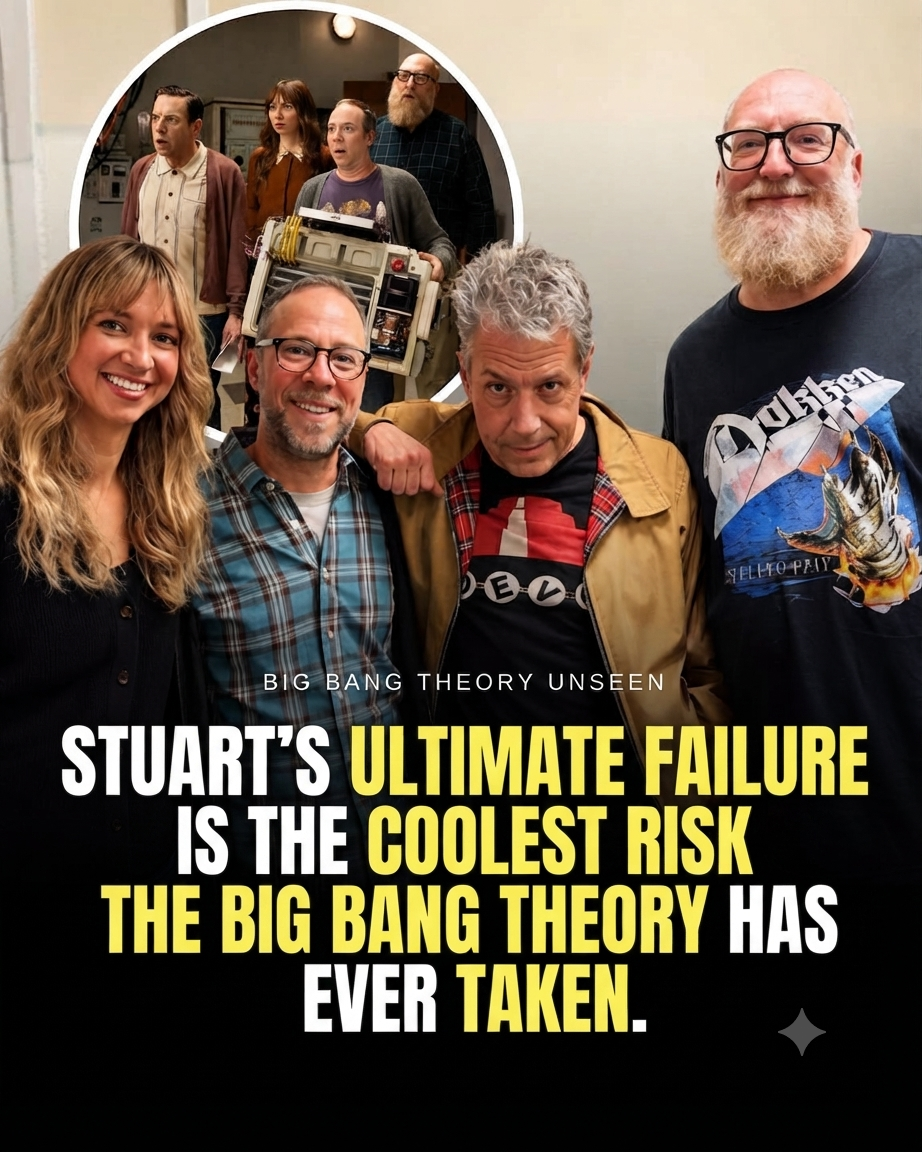
Few television franchises are willing to abandon the formula that made them famous. After nearly two decades of laugh tracks, apartment conversations, and sitcom storytelling, The Big Bang Theory universe has finally taken its biggest creative gamble—and the result is unlike anything fans have seen before.
When Stuart Fails to Save the Universe premiered on HBO Max on July 23, 2026, it immediately became the most unconventional project ever produced within The Big Bang Theory franchise.
Instead of another traditional sitcom, viewers were introduced to a fast-paced science fiction adventure filled with alternate universes, artificial intelligence, action sequences, and a group of unlikely heroes trying to stop a multiverse catastrophe.
It was a dramatic departure from everything audiences expected—and that was entirely the point.
A Completely New Direction for The Big Bang Theory Universe
For nearly twenty years, The Big Bang Theory built its identity around a classic multi-camera sitcom format.
The series thrived on witty dialogue, character-driven comedy, and relationships that unfolded primarily inside familiar apartments, university offices, and comic book stores.
Even Young Sheldon and Georgie & Mandy's First Marriage remained grounded in family comedy.
Stuart Fails to Save the Universe changes all of that.
The series embraces science fiction on a scale the original sitcom could only joke about.
Rather than focusing on everyday life in Pasadena, the story follows four supporting characters as they travel across multiple realities after an unexpected disaster threatens the multiverse itself.
It's an ambitious premise that transforms one of television's biggest sitcoms into a full-scale sci-fi adventure.
The Unlikeliest Heroes Take Center Stage
One of the show's biggest surprises is its choice of protagonists.
Instead of following Sheldon, Leonard, Penny, or Amy, the story revolves around characters who were often supporting players in the original series.
They're ordinary people suddenly placed in extraordinary circumstances.
Unlike traditional action heroes, these characters aren't trained to save universes.
They're simply trying to survive while navigating bizarre alternate realities filled with unexpected dangers.
That contrast between everyday personalities and impossible situations becomes one of the show's biggest sources of comedy.
The characters don't suddenly become fearless superheroes.
They remain awkward, confused, and hilariously underprepared—which keeps the story connected to the spirit of The Big Bang Theory even as it explores completely new territory.
Chuck Lorre Wanted to Leave His Comfort Zone
Behind the series is an impressive creative team.
The show was co-created by Chuck Lorre, Bill Prady, and Zak Penn, whose background includes writing major superhero and science-fiction films.
Their combined experience helped shape a project unlike anything previously attempted within the franchise.
Lorre has openly explained why he wanted to make such a dramatic creative shift.
"I just wanted to do something that challenged me, that I was uncomfortable and in unfamiliar territory."
That philosophy is visible throughout the series.
Rather than repeating the formula that made The Big Bang Theory one of television's biggest sitcoms, the creators chose to experiment with new genres, larger visual effects, and far more ambitious storytelling.
Critics Responded With Mixed—but Mostly Positive—Reviews
Whenever a beloved franchise reinvents itself, strong opinions are inevitable.
That has certainly been true for Stuart Fails to Save the Universe.
The series currently holds a 67% Fresh rating on Rotten Tomatoes and a 72 score on Metacritic, reflecting generally positive reviews while acknowledging that the show's bold experimentation won't appeal to everyone.
Many critics praised its originality.
Variety's Alison Herman described it as a spinoff that "actually comes up with a creative angle" in an era filled with predictable franchise expansions.
The Wrap called it "a strange but addictive spinoff" with "a brilliant and wild premise," adding that it's difficult not to become attached to its unlikely heroes.
FandomWire praised the show as "not only funny but endlessly clever," highlighting its inventive storytelling and ambitious world-building.
Not every review was entirely enthusiastic.
The Hollywood Reporter described the series as "occasionally fun, frequently frustrating," suggesting that its biggest ideas sometimes outpaced their execution.
Meanwhile, TV Guide's Liam Mathews argued that the central characters didn't experience enough development throughout the season to fully support the larger narrative.
A Franchise Finally Taking Creative Risks
Whether viewers love every episode or not, one point has emerged consistently across critical reviews:
The show deserves credit for trying something completely different.
Instead of simply recreating The Big Bang Theory with new characters, the creators built an entirely different type of series.
The multiverse setting allows the writers to revisit familiar faces in unexpected ways while exploring alternate realities that could never have existed within the original sitcom.
For longtime fans, that creates endless possibilities.
Characters audiences thought they knew can suddenly appear with completely different personalities, histories, and motivations.
That unpredictability gives the franchise fresh creative energy.
More Than Just Fan Service
Many television spinoffs rely heavily on nostalgia.
While Stuart Fails to Save the Universe certainly includes references for longtime fans, the series also works to establish its own identity.
Rather than depending entirely on callbacks and familiar jokes, it introduces larger science-fiction concepts, original conflicts, and visual storytelling that separate it from its predecessor.
The result feels less like another season of The Big Bang Theory and more like a genuine expansion of its fictional universe.
That ambition may divide audiences, but it also prevents the series from feeling repetitive.
Could This Shape the Future of the Franchise?
The success of Young Sheldon proved that The Big Bang Theory universe could support stories beyond the original sitcom.
Now, Stuart Fails to Save the Universe pushes that idea even further.
If audiences continue embracing genre experimentation, the franchise could eventually explore even more unexpected directions.
Instead of remaining confined to traditional sitcom storytelling, future projects may combine comedy with science fiction, fantasy, or entirely different genres.
Whether that happens remains to be seen, but this series has already demonstrated that the creative team isn't afraid to take risks.
No comments yet