The Big Bang Theory universe has reached an unusual point in its history.
More than seven years after the original sitcom came to an end, its fictional world is not simply being revisited through one traditional spin-off. Instead, the franchise is expanding in dramatically different directions at the same time — with one series embracing the familiar comfort of the classic sitcom and another throwing its characters into a wildly ambitious multiverse adventure.
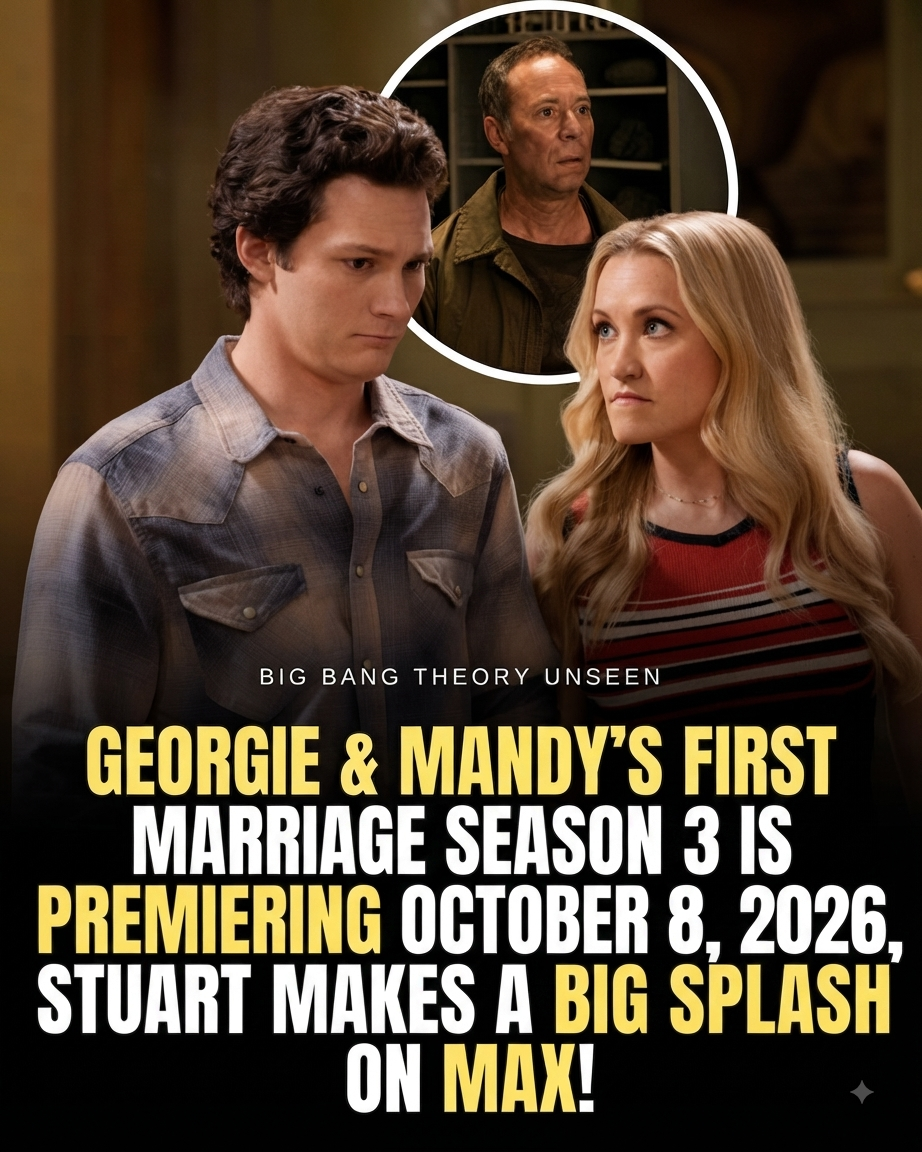
On one side is Georgie & Mandy's First Marriage, the continuing branch of the Young Sheldon storyline that remains firmly rooted in the traditional multi-camera sitcom format.
On the other is Stuart Fails to Save the Universe, a far more experimental project that takes characters from The Big Bang Theory and places them inside a science-fiction story involving alternate realities, bizarre new worlds, and a multiverse-threatening crisis.
The contrast could hardly be greater.
And yet, both shows are doing something important: proving that the world created by Chuck Lorre, Bill Prady, Steve Molaro, and their collaborators is flexible enough to support very different kinds of storytelling.
Two Shows, Two Completely Different Visions
For twelve seasons, The Big Bang Theory established a very specific visual and comedic identity.
The familiar Pasadena apartments. The Caltech campus. The comic book store. The Cheesecake Factory. The group gathered around a table or sitting together in Apartment 4A.
It was a traditional multi-camera sitcom built around a relatively contained world.
Even when the characters traveled, became astronauts, attended conventions, got married, or encountered famous scientists, the series always returned to the same fundamental environment.
That consistency became part of the show's appeal.
Georgie & Mandy's First Marriage continues that tradition.
The series remains connected to the Young Sheldon side of the franchise and follows Georgie Cooper and Mandy McAllister as they attempt to build a life together while dealing with marriage, parenthood, family expectations, and the complicated realities of growing up before either of them is truly ready.
The setting is also completely different from Pasadena.
Instead of California laboratories and university apartments, the story unfolds in 1990s Texas, where family relationships provide much of the comedy and emotional conflict.
Meanwhile, Stuart Fails to Save the Universe is doing almost the exact opposite.
Rather than preserving the established sitcom formula, the series takes Stuart Bloom, Bert Kibbler, Barry Kripke, and other familiar faces and throws them into an entirely different genre.
It is a science-fiction action-adventure comedy built around alternate universes and a crisis that is considerably larger than anything the characters experienced in the original series.
The franchise, essentially, is now telling two completely different stories at once.
Georgie and Mandy Keep the Sitcom Tradition Alive
The continued success of Georgie & Mandy's First Marriage represents something significant for the franchise.
The series does not need to reinvent the format to remain relevant.
Instead, it understands that there is still an audience for the kind of character-driven, family-centered comedy that made Young Sheldon successful.
Montana Jordan and Emily Osment continue in the central roles of Georgie Cooper and Mandy McAllister, portraying a young couple attempting to balance marriage, parenthood, and the expectations of their families.
Their relationship gives the series a very different emotional foundation from The Big Bang Theory.
The original sitcom was largely about friendship and the gradual formation of a chosen family.
Young Sheldon and its sequel are much more concerned with biological family, responsibility, childhood, marriage, and the complicated transition into adulthood.
That difference gives the franchise room to explore another side of the Cooper family.
Georgie was originally introduced as Sheldon's older brother, often portrayed as less academically gifted and considerably more interested in practical matters than his younger sibling.
But the later stories gradually revealed that Georgie possessed qualities Sheldon lacked — particularly business instincts, emotional awareness, and an ability to understand people in ways that his genius brother frequently struggled to do.
His relationship with Mandy therefore became more than a simple romantic subplot.
It became an opportunity to show Georgie becoming an adult.
The Series Is Staying With Its Traditional Format
One of the most interesting aspects of Georgie & Mandy's First Marriage is how deliberately it preserves the classic sitcom experience.
The series uses the multi-camera format and live-audience tradition associated with The Big Bang Theory and Young Sheldon.
That continuity matters.
There is something immediately recognizable about watching a Big Bang Theory universe story unfold in front of a studio audience. The rhythm is different from single-camera comedy. Jokes are designed around audience reactions, performances have a theatrical quality, and scenes can breathe differently because actors are playing to a room full of people.
It creates a connection to the original franchise without requiring the same characters or setting.
For longtime viewers, that familiarity can be comforting.
The franchise may be expanding, but one branch of it still feels unmistakably like home.
Then There Is Stuart Fails to Save the Universe
If Georgie & Mandy's First Marriage represents continuity, Stuart Fails to Save the Universe represents experimentation.
The series takes characters who were never originally designed to carry an entire franchise and gives them an entirely new mission.
Stuart Bloom was introduced on The Big Bang Theory as the struggling owner of the comic book store. Bert Kibbler was the socially awkward geologist who gradually became a more important member of the extended group. Barry Kripke was one of the show's recurring academic rivals and occasional sources of chaos.
None of them seemed like obvious candidates to lead a science-fiction adventure.
That is precisely what makes the concept so unusual.
Rather than simply recreating The Big Bang Theory with different characters, the new series asks a completely different question:
What happens when these familiar personalities are placed into a world where the rules have changed?
The answer is a show involving alternate realities, strange versions of familiar characters, and consequences that would have been almost impossible to imagine within the original sitcom.
It is a much bigger swing creatively.
The Multiverse Gives the Franchise Unlimited Possibilities
The multiverse concept is particularly useful because it allows the writers to revisit familiar characters without being trapped by established continuity.
A character can be heroic in one universe and completely different in another.
Someone who survived for twelve seasons in the original timeline can potentially face an entirely different fate elsewhere.
Relationships can change.
Personalities can be exaggerated.
Characters can encounter versions of people they once knew.
And perhaps most importantly, the writers can tell stories that would never have been possible inside the original show's relatively grounded world.
That freedom is already evident in the show's willingness to place familiar characters in genuinely dangerous situations.
For longtime Big Bang Theory viewers, that can be both exciting and slightly unsettling.
The original series was ultimately a comfort sitcom.
Stuart Fails to Save the Universe is willing to remind viewers that, in a multiverse, almost anything can happen.
Why the Contrast Actually Works
At first glance, the two shows might seem incompatible.
One is a traditional family sitcom set in 1990s Texas.
The other is an ambitious science-fiction comedy involving alternate universes.
One looks backward at the Cooper family.
The other looks outward into an almost limitless fictional universe.
But that difference may actually be the smartest thing the franchise could have done.
Trying to recreate The Big Bang Theory exactly would inevitably invite comparisons to the original.
Instead, the franchise is separating its stories by genre.
Georgie & Mandy's First Marriage gives viewers the familiar emotional rhythms of a sitcom.
Stuart Fails to Save the Universe gives viewers something they have never seen from this universe before.
The result is a franchise that can appeal to different parts of the original audience without forcing every viewer to want the same thing.
The Franchise Has Come a Long Way From Apartment 4A
It is remarkable to consider where this universe began.
In 2007, The Big Bang Theory was essentially a story about four scientists living across the hall from an aspiring actress.
The world was small.
The characters were tightly contained.
The comedy came from their personalities, relationships, misunderstandings, and obsessions.
Then came Amy and Bernadette.
Then came Young Sheldon, which expanded the universe backward in time and explored Sheldon's childhood.
Then came Georgie & Mandy's First Marriage, continuing the story of the Cooper family beyond Young Sheldon.
And now comes a series willing to break the boundaries of reality itself.
The franchise has effectively moved from one apartment to an entire multiverse.
That is an extraordinary evolution for a sitcom universe that originally depended on a handful of characters sitting around a living room.
What the Future Could Look Like
The success of these two very different approaches could ultimately determine how much further the franchise expands.
If Georgie & Mandy's First Marriage continues to thrive, it demonstrates that audiences still want traditional stories centered around familiar characters and family relationships.
If Stuart Fails to Save the Universe succeeds, it demonstrates that the franchise can survive outside the sitcom format entirely.
Together, they create an interesting blueprint.
The future of The Big Bang Theory does not necessarily have to mean another show that looks like The Big Bang Theory.
It could mean different corners of the universe doing completely different things.
A family comedy in Texas.
A multiverse adventure.
Perhaps eventually another story set somewhere else entirely.
The possibilities are suddenly much broader than they were when the original series ended.
The Most Interesting Part Is the Contrast
There is something almost poetic about having these two shows exist at the same time.
One is concerned with the ordinary problems of young marriage and raising a family.
The other is concerned with problems that could potentially destroy entire realities.
Georgie and Mandy are worrying about relationships, parents, money, and responsibility.
Stuart and his unlikely group are worrying about alternate universes.
Yet both stories are still built from the same fundamental ingredient that made The Big Bang Theory work in the first place: characters trying to figure out how to survive life together.
The scale has changed.
The genre has changed.
The setting has changed.
But the emotional foundation remains surprisingly familiar.
Final Thoughts
The Big Bang Theory universe is no longer a single sitcom.
It has become a growing television franchise capable of supporting multiple generations, multiple formats, and completely different storytelling styles.
Georgie & Mandy's First Marriage represents the comfortable side of that evolution — a continuation of the family-centered sitcom tradition that Young Sheldon established.
Stuart Fails to Save the Universe represents the opposite — a willingness to take familiar characters somewhere completely unexpected and see what happens when the rules of their world disappear.
And perhaps that is the most encouraging sign for the future of the franchise.
No comments yet