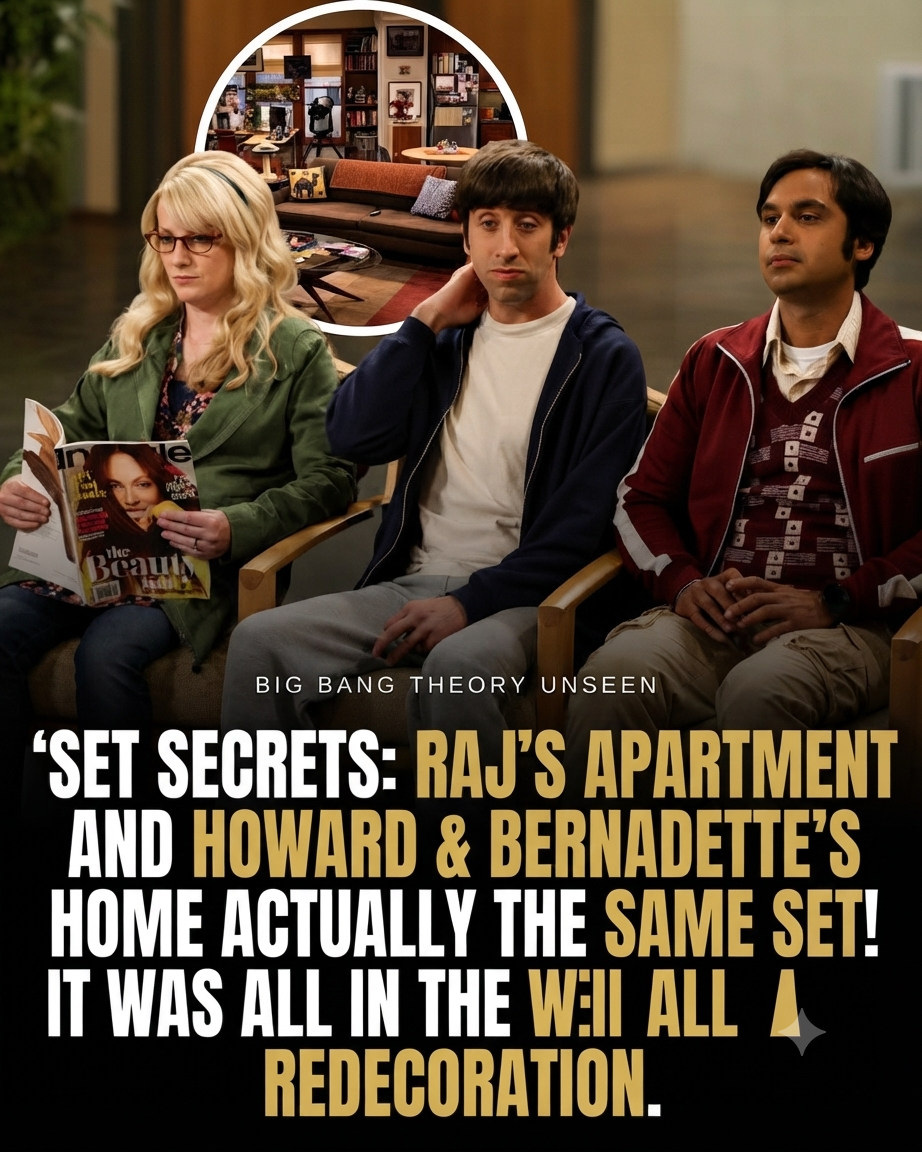
One of the biggest behind-the-scenes surprises from The Big Bang Theory wasn't a casting decision or an improvised scene—it was a television production trick that fooled viewers for twelve seasons.
Most fans assumed Raj Koothrappali's apartment and the home shared by Howard and Bernadette Wolowitz were two completely different sets.
In reality, they were the very same space.
One Set, Two Different Homes
Although the two homes looked nothing alike on screen, they were actually built from the same physical set.
Instead of constructing two permanent locations, the production team simply transformed the room whenever the script required a different apartment.
With new furniture, artwork, lighting, props, and color schemes, the same space became either Raj's stylish bachelor apartment or Howard and Bernadette's warm family home.
It was a clever solution that saved both time and production costs while remaining completely invisible to viewers.
The Magic of Set Design
Making the illusion believable required an enormous amount of work from the show's talented set decoration department.
Every transformation meant replacing furniture, rearranging decorations, changing wall art, and adding dozens of carefully selected details that reflected each character's personality.
Raj's apartment had a very different atmosphere from Howard and Bernadette's home, yet both environments felt completely authentic because of the attention to detail behind every scene.
The result was a seamless illusion that most fans never questioned.
Why You Rarely Saw Both Homes Together
This production trick also explains something longtime viewers may have noticed.
It's surprisingly uncommon for Raj's apartment and Howard and Bernadette's house to appear in the same episode.
The reason wasn't creative—it was practical.
Showing both locations during the same filming schedule meant the crew had to completely dismantle and rebuild the set between scenes.
Rather than spending hours transforming the room multiple times in a single day, the writers often avoided scripts that required frequent visits to both locations.
It was a simple production decision that helped filming run far more efficiently.
A Perfect Example of Television Magic
Throughout its twelve-season run, The Big Bang Theory earned praise for creating a believable world filled with memorable locations and recognizable homes.
Few viewers ever realized that two of those familiar places were actually the exact same set wearing different "clothes."
It's a reminder that some of television's greatest illusions don't rely on special effects—they depend on the creativity of production designers, set decorators, and crew members working behind the scenes.


No comments yet