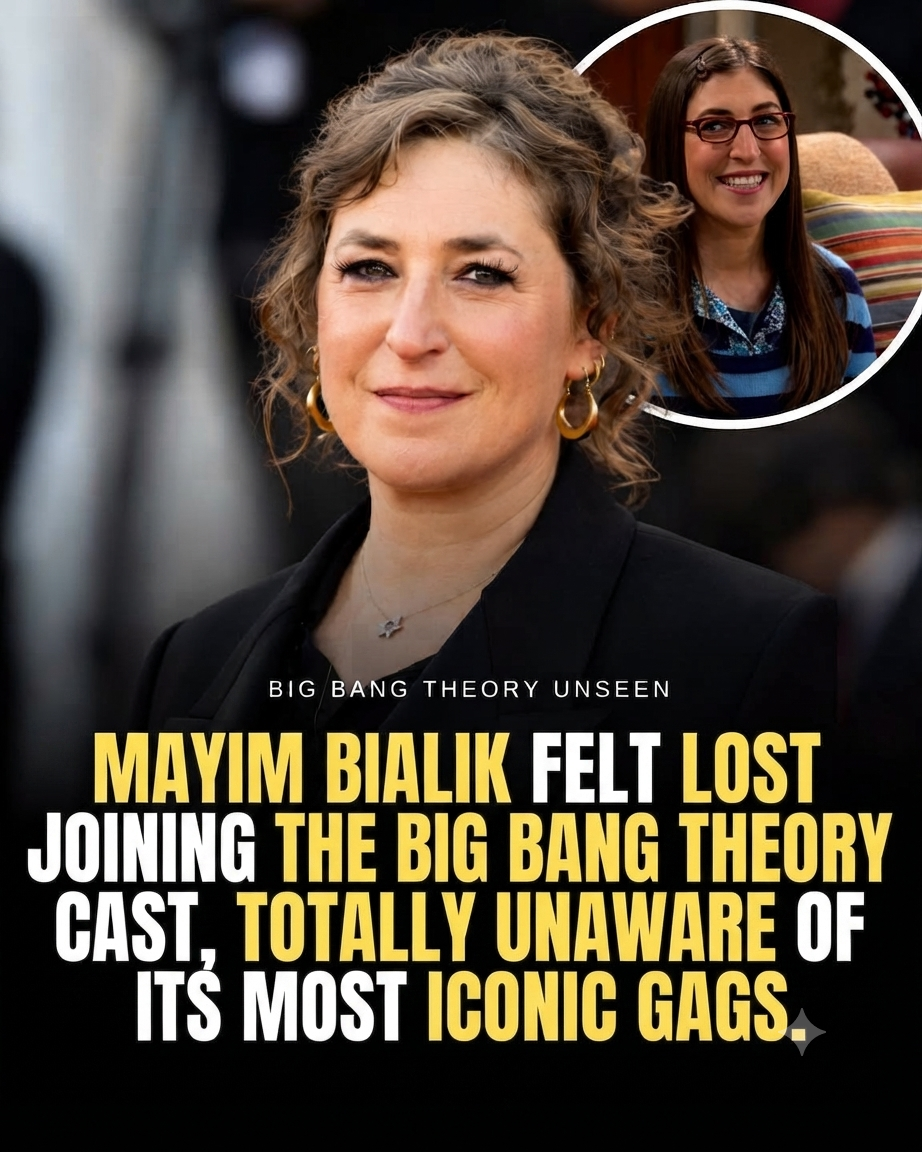
Few fans realize that becoming one of The Big Bang Theory's most beloved characters wasn't nearly as easy for Mayim Bialik as it looked on television.
By the time Amy Farrah Fowler made her unforgettable debut in the Season 3 finale, The Big Bang Theory had already become one of television's biggest sitcoms. The cast had spent years building friendships, perfecting their chemistry, and creating a unique comedic rhythm that millions of viewers had fallen in love with.
Stepping into that environment wasn't simply another acting job.
For Mayim Bialik, it felt like entering an entirely different world.
Years later, the actress openly admitted that she initially felt like a complete outsider trying to understand a television family that had already existed long before she arrived.
Ironically, the woman who would eventually become one half of the show's most iconic couple didn't even fully understand many of the series' biggest running jokes.
Joining an Established Sitcom Wasn't Easy
When Bialik joined the cast in 2010, The Big Bang Theory had already completed three successful seasons.
The original cast—Jim Parsons, Johnny Galecki, Kaley Cuoco, Simon Helberg, and Kunal Nayyar—had spent years working together. Their friendships had grown naturally both on and off the set, and the writers had carefully developed the personalities, quirks, and traditions that made each character instantly recognizable.
For a newcomer, fitting into that environment wasn't as simple as memorizing lines.
Bialik later explained that arriving on set felt almost like moving to a foreign country where everyone already understood the language except her.
She described herself as feeling like an alien trying to learn an entirely new culture.
She Didn't Even Know Some of the Show's Biggest Running Gags
Perhaps the most surprising part of Bialik's experience was discovering just how much series history she didn't know.
Although millions of fans had already become familiar with Sheldon's obsession over his famous spot on the couch, Bialik admitted she wasn't fully aware of how important that joke had become within the series.
Likewise, Raj Koothrappali's selective mutism—his inability to speak to women without alcohol—was another long-running storyline she had little knowledge of when she first joined.
To longtime viewers, these details were second nature.
To Bialik, they were pieces of an enormous puzzle she had to learn while simultaneously introducing an entirely new character.
It demonstrated just how rich and detailed The Big Bang Theory's world had already become before Amy Farrah Fowler ever appeared.
Amy Was Originally Never Meant to Change the Series Forever
When Amy first appeared in the Season 3 finale, nobody knew how important the character would eventually become.
She was introduced after Howard and Raj secretly created an online dating profile for Sheldon Cooper, believing they had finally found someone intellectually compatible with their socially awkward friend.
Initially, Amy's appearance felt more like an interesting experiment than a permanent addition.
Even the writers couldn't have predicted how dramatically she would reshape the future of the sitcom.
What happened next surprised almost everyone.
Jim Parsons and Mayim Bialik Created Instant Chemistry
Although Bialik was still learning the show's history, something clicked immediately whenever she shared scenes with Jim Parsons.
Their performances felt natural.
Rather than forcing a traditional sitcom romance, the writers recognized that the chemistry between Sheldon and Amy deserved time to develop.
Instead of rushing the relationship, they allowed it to evolve gradually over several seasons.
Friendship slowly became affection.
Affection became love.
Eventually, the pair married and fulfilled one of the series' biggest storylines by winning the Nobel Prize in Physics together during the finale.
Looking back, it's difficult to imagine The Big Bang Theory without Amy—even though her actress once felt completely out of place.
From Newcomer to Fan Favorite
Over the years, Amy Farrah Fowler transformed from an awkward guest character into one of the emotional pillars of the series.
Her friendship with Penny and Bernadette added entirely new dimensions to the show's storytelling.
Her relationship with Sheldon became one of television's greatest slow-burn romances.
And Bialik herself became so closely associated with the role that many fans now struggle to imagine the show without her.
It's remarkable to think that the actress behind one of the sitcom's most beloved characters once worried she didn't fully belong.
A Reminder That Every TV Family Starts Somewhere
One of the reasons this behind-the-scenes story resonates so strongly is because it's surprisingly relatable.
Whether joining a new workplace, school, or group of friends, almost everyone has experienced the uncomfortable feeling of arriving after everyone else already knows one another.
Mayim Bialik experienced exactly that.
The difference is that her new workplace happened to be one of the biggest sitcoms in television history.
Instead of letting uncertainty overwhelm her, she embraced the challenge, learned the show's unique world, and gradually became one of its defining stars.
Final Thoughts
Today, Amy Farrah Fowler is impossible to separate from The Big Bang Theory's legacy.
Her romance with Sheldon Cooper remains one of the sitcom's greatest achievements, and Mayim Bialik's performance earned widespread praise throughout the series' later seasons.
That's what makes her early experience so fascinating.
Before she became one of the show's most beloved cast members, she was simply a newcomer trying to understand years of inside jokes, established friendships, and television history.


No comments yet