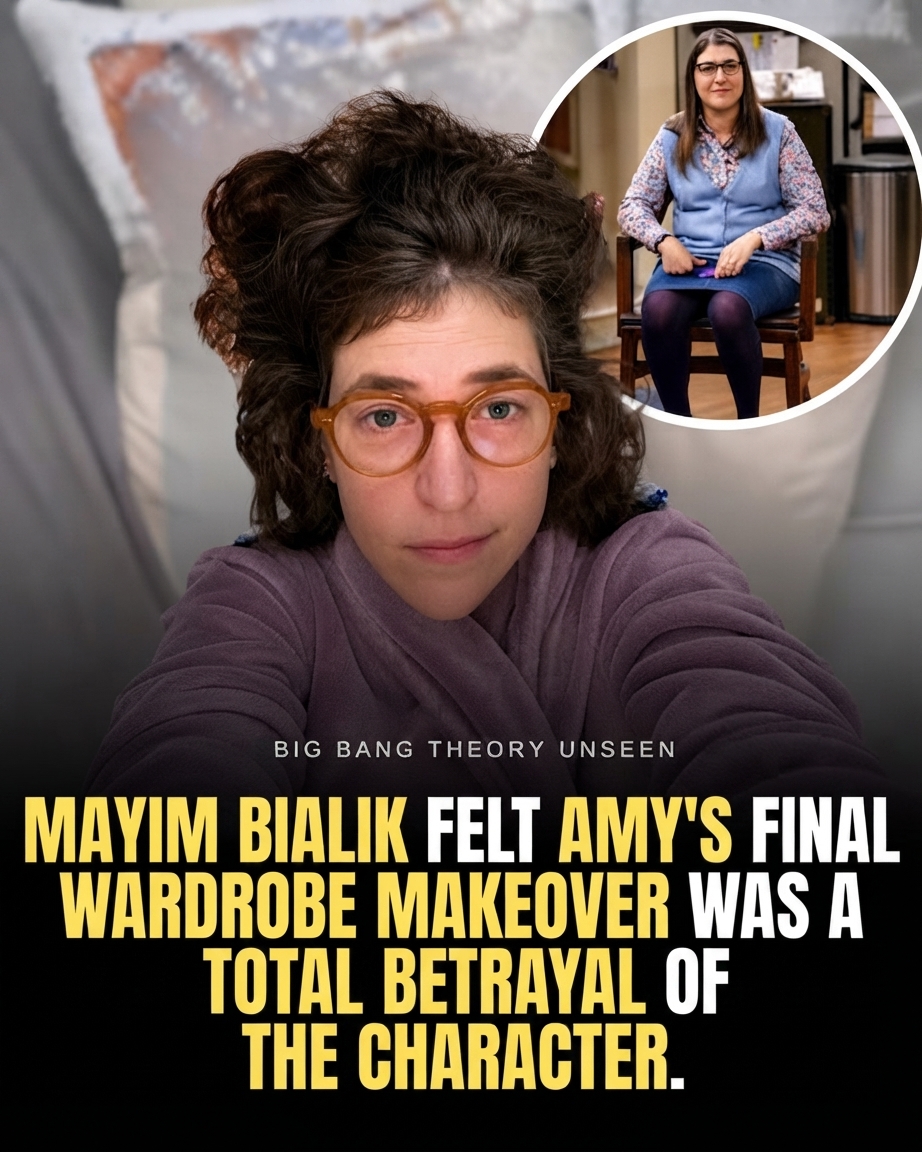
The Big Bang Theory Gave Amy Farrah Fowler a Makeover—But Mayim Bialik Didn't Expect It to Last
For most of The Big Bang Theory, Amy Farrah Fowler's wardrobe was more than just a collection of old-fashioned cardigans and plaid blouses. It was part of the character.
Layered sweaters.
Plaid shirts.
Denim skirts.
Practical shoes.
And, of course, Amy's signature glasses.
Her clothes immediately communicated something about the character.
Amy wasn't interested in impressing anyone.
She didn't dress for attention.
She dressed for comfort and practicality.
But behind that deliberately frumpy appearance was an actress who had actually wanted to explore something very different.
Mayim Bialik had wanted Amy to have a makeover for years.
The surprising part was what happened when she finally got one.
Amy's Wardrobe Was Part of Her Identity
When Amy first appeared, her appearance was almost the opposite of Penny's.
Penny represented conventional sitcom glamour.
Amy represented academic practicality.
The contrast was intentional.
Amy was a neuroscientist who cared far more about science, research and her relationship with Sheldon than she did about fashion.
Her clothes became part of the joke.
The cardigans.
The conservative skirts.
The glasses.
The deliberately awkward combinations.
Everything reinforced the idea that Amy had never considered fashion particularly important.
And over time, viewers became so accustomed to the look that it effectively became part of her identity.
But Mayim Bialik Wanted to See Another Side of Amy
Interestingly, Bialik wasn't opposed to changing Amy's appearance.
Quite the opposite.
She had repeatedly talked about wanting an "ugly duckling" makeover episode.
The idea wasn't necessarily to completely transform Amy.
Bialik had imagined an opportunity to temporarily dress the character differently and allow audiences to see another side of her.
For years, the idea remained something she talked about but never actually got.
Then, during the final season, the writers finally did it.
The Makeover Came After Amy and Sheldon's Nobel Win
Amy's transformation arrived after she and Sheldon won the Nobel Prize in Physics.
It was a fitting moment for the character.
Amy had grown enormously since her first appearance.
Her relationship with Sheldon had matured.
Her career had progressed.
And she had become one of the show's central characters.
So changing her wardrobe could be interpreted as another visual representation of that evolution.
But there was a problem.
The change didn't remain temporary.
Bialik Thought It Would Be One Night
Bialik had imagined something much simpler.
Amy could dress up.
She could experience the attention.
She could have her glamorous moment.
And then she could return to the Amy audiences had known for years.
Instead, the makeover became part of Amy's new normal.
That wasn't what Bialik had expected.
She later described the feeling as somewhat like a betrayal of the character she had spent years developing.
The issue wasn't that Amy looked more fashionable.
It was that something that had been central to Amy's identity suddenly disappeared.
Amy's Appearance Had Always Been About More Than Clothes
That's what made the makeover surprisingly complicated.
Amy's wardrobe wasn't merely a costume.
It communicated her personality.
Changing it permanently changed how audiences visually interpreted her.
The original Amy had never needed to conform to conventional ideas of femininity.
She was comfortable being different.
She was brilliant.
She was awkward.
And she eventually found someone who loved her exactly as she was.
That made the sudden emphasis on her appearance feel slightly contradictory to the character's journey for some viewers.
The Real-World Reaction Was Also Complicated
Bialik has spoken about how Amy's appearance affected the way people perceived her outside the show.
She sometimes received what sounded like compliments but were actually revealing of the stereotype created by the character.
People would express surprise that Bialik herself looked different from Amy.
The implication was that the "frumpy female scientist" viewers saw on television had become so convincing that some people unconsciously assumed the actress looked the same way.
That experience highlighted how powerful television's visual shorthand can be.
Amy Was Never Supposed to Be Penny
One of the most important things about Amy's appearance was how differently the show presented her compared with Penny.
Penny was conventionally glamorous.
Amy wasn't.
But the show eventually allowed both women to develop without requiring Amy to become Penny.
Amy's intelligence, personality and relationship with Sheldon were supposed to make her compelling.
Her appearance wasn't meant to be the source of her value.
That's why the permanent makeover remains an interesting creative decision.
It gave Amy a new look.
But it also changed one of the visual distinctions that had helped define her for nearly a decade.
Final Thoughts
Mayim Bialik had wanted an Amy makeover for years.
So when the writers finally gave her one, it should have been exactly what she wanted.
But television has a funny way of turning temporary ideas into permanent changes.
Bialik had imagined a one-night transformation.
The show gave Amy a lasting wardrobe evolution.
And suddenly, something that had once been a simple character joke became a surprisingly complicated creative decision.
She wanted the makeover.
She just didn't expect the makeover to become Amy's new identity.


No comments yet