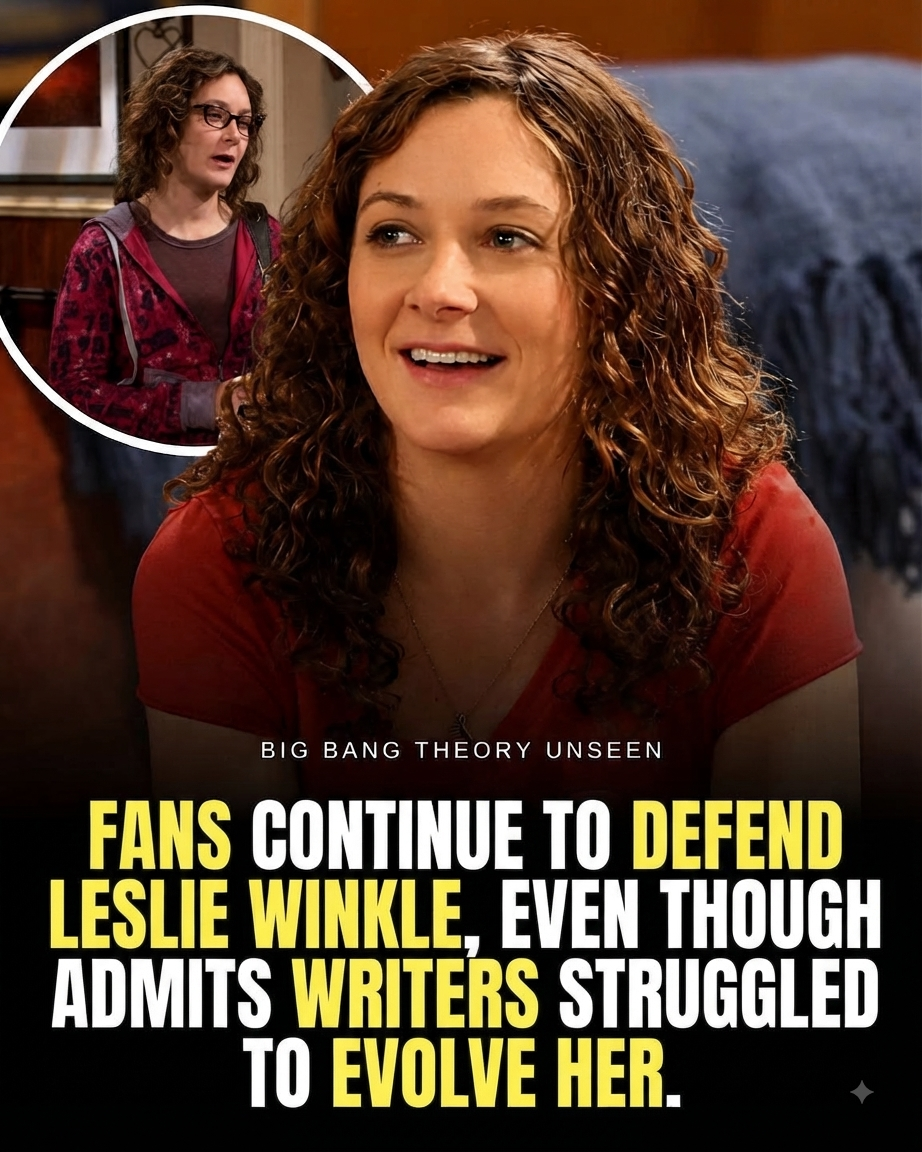
Some television characters disappear so quietly that casual viewers barely notice. Others disappear and leave fans wondering for years why the writers ever let them go in the first place. Leslie Winkle belongs firmly in the second category.
Played by Sara Gilbert, Leslie was one of the earliest recurring characters to prove that the scientific world of The Big Bang Theory didn't belong exclusively to Sheldon Cooper, Leonard Hofstadter, and their male friends.
She was intelligent.
She was sarcastic.
She was confident.
And perhaps most importantly, she wasn't remotely intimidated by Sheldon.
For a character who appeared only intermittently throughout the series, Leslie made an unusually strong impression.
She could challenge Sheldon intellectually, understood Leonard's world almost instinctively, and brought a completely different kind of energy to the show's Caltech environment.
Yet as the series evolved, Leslie gradually disappeared.
She would occasionally return for an episode, but the character was never developed into the major presence many fans believed she could have become.
That has made Leslie Winkle one of the show's most frequently defended underused characters.
The Female Counterpart to Leonard
One of the smartest things about Leslie's introduction was how naturally she fit into the existing scientific world.
Leslie wasn't introduced as a generic love interest.
She wasn't simply "the girl scientist."
She was essentially Leonard's intellectual counterpart.
The similarities were obvious.
Like Leonard, she was a physicist working at Caltech. She wore glasses, dressed casually, and existed comfortably inside the highly academic environment surrounding the show's main characters.
But there was one major difference.
Leslie had considerably less patience for nonsense.
Where Leonard often tried to keep the peace, Leslie was perfectly happy to confront people.
And when the person standing in front of her was Sheldon Cooper, that willingness to fight made her immediately entertaining.
She didn't worship Sheldon's intelligence.
She didn't treat his opinions as automatically correct.
And she certainly wasn't afraid to tell him when she thought he was being ridiculous.
That made her presence feel refreshing from the beginning.
Sheldon Finally Met Someone Who Would Fight Back
Sheldon had spent much of the early series establishing himself as the intellectual authority of the group.
Leonard might challenge him occasionally.
Raj and Howard could make jokes at his expense.
But none of them could consistently match Sheldon in his preferred arena: scientific argument.
Leslie could.
Their rivalry was therefore different from almost every other relationship Sheldon had at that stage.
She wasn't simply annoyed by his personality.
She could actually challenge his scientific reasoning.
That gave their arguments another layer.
Sheldon couldn't simply dismiss Leslie as unintelligent because she wasn't.
He couldn't easily outmaneuver her through obscure scientific terminology because she understood the subject.
And he couldn't intimidate her because she simply wasn't impressed.
For Sheldon, that was a nightmare.
For viewers, it was comedy gold.
Leslie was one of the rare characters who could walk into a scene with Sheldon and immediately change the balance of power.
Their Rivalry Was One of the Show's Early Highlights
Some of the show's earliest episodes benefited enormously from Leslie's presence because she gave Sheldon something he desperately needed: a genuine intellectual opponent.
Their scientific rivalry wasn't based entirely on personal dislike.
It was also about competition.
Both characters believed they were right.
Both were extremely intelligent.
Both were stubborn.
And neither particularly enjoyed being challenged.
That combination created a kind of conflict The Big Bang Theory would later reproduce through other characters, but Leslie was there very early in the show's development.
She demonstrated that the series could create compelling female characters without making their primary purpose romantic.
Leslie didn't need to date someone to justify her existence.
Her scientific ability was enough.
Her personality was enough.
Her rivalry with Sheldon was enough.
That made her particularly important to the show's early identity.
Leslie and Leonard Were Another Missed Opportunity
Leslie's connection with Leonard also gave the writers an opportunity they never fully explored.
The two understood each other's professional world.
They shared similar scientific interests.
They had comparable personalities in certain respects.
And, naturally, the show explored their romantic relationship.
But the relationship was never developed into a major storyline.
Instead, Leslie remained a recurring presence who would appear, create chaos, deliver several excellent jokes, and then disappear again.
There was something fascinating about seeing Leonard interact with someone who understood his academic life without needing an explanation.
Penny was obviously important to Leonard's character development, but she came from a completely different world.
Leslie represented what Leonard's life might have looked like if he had pursued a relationship with someone who shared almost every aspect of his intellectual environment.
That contrast could have produced considerably more storytelling.
Instead, the show largely moved on.
Sara Gilbert Understood Exactly What Made Leslie Work
A major reason Leslie remains memorable is Sara Gilbert's performance.
Gilbert played Leslie with a dry, understated confidence that worked beautifully against the more exaggerated personalities surrounding her.
She didn't need to shout.
She didn't need elaborate physical comedy.
She could simply look at Sheldon and deliver a sarcastic response.
The comedy came from the contrast between her calm confidence and his increasingly frustrated reaction.
That restraint was important.
Leslie didn't feel like a female version of Sheldon.
She was something more interesting.
She was a highly intelligent scientist who possessed Sheldon's confidence in her own intellect but had considerably more awareness of how ridiculous other people could be.
That distinction gave her an identity of her own.
The Writers Eventually Hit a Wall
Perhaps the most revealing part of Leslie's story is that Sara Gilbert herself has acknowledged the character's limitations.
On The Official Big Bang Theory Podcast, Gilbert discussed the difficulties surrounding Leslie's continued development and suggested that the writers eventually struggled to find somewhere meaningful for the character to go.
That admission helps explain why Leslie's appearances became increasingly infrequent.
The problem wasn't necessarily that the character didn't work.
The problem was that the show wasn't sure what story it wanted to tell with her.
That is an important distinction.
A character can be popular and still be difficult to write.
Leslie had already established her identity.
She was a physicist.
She was sarcastic.
She challenged Sheldon.
She had a complicated relationship with Leonard.
But after those elements had been explored, what was next?
The series never found a definitive answer.
Then Amy Farrah Fowler Changed the Equation
The arrival of Amy Farrah Fowler made Leslie's position within the show's ensemble even more complicated.
Amy wasn't simply another intelligent woman.
She became Sheldon's romantic partner and eventually one of the central characters of the entire series.
That gave her an enormous narrative advantage.
Amy could participate in Sheldon's intellectual world while simultaneously becoming part of his emotional development.
She wasn't just his scientific equal.
She was his partner.
As the show increasingly focused on Sheldon's relationship with Amy, Leslie's original function became less necessary.
The series no longer needed Leslie to demonstrate that Sheldon could be challenged by an intelligent woman.
Amy was doing that in a much larger storyline.
And while the two characters were fundamentally different, their overlapping position within Sheldon's intellectual world made Leslie easier to leave behind.
Leslie Proved That Women Belonged in the Scientific World
One of Leslie's most important contributions to The Big Bang Theory was simply her existence.
She was a woman working successfully in physics.
She wasn't there as decoration.
She wasn't there merely to provide romance.
She was a legitimate scientist who could compete with the men around her.
That became increasingly significant as the show introduced Amy and Bernadette.
Eventually, The Big Bang Theory developed a much stronger group of female characters with their own scientific and professional identities.
But Leslie was there first.
She helped establish the idea that the show's scientific world could contain women who were just as intelligent, ambitious, competitive, and eccentric as its male characters.
In that sense, her contribution to the series was larger than her episode count might suggest.
Her Absence Became More Noticeable as the Show Grew
There is an interesting irony to Leslie's disappearance.
The more successful The Big Bang Theory became, the larger its ensemble grew.
Amy became central.
Bernadette became central.
Penny developed considerably beyond her original role.
The show became increasingly interested in relationships, careers, marriage, and personal development.
Yet Leslie remained largely outside that evolution.
That made her absence increasingly noticeable.
She represented a version of The Big Bang Theory that had gradually disappeared.
The early series was heavily focused on Caltech, physics, academic competition, and the strange social ecosystem created by four highly intelligent men.
Leslie fit naturally into that world.
As the show transformed into a broader ensemble comedy, her specific function became less obvious.
Fans Still Want More Leslie
The fact that fans continue discussing Leslie years after her last meaningful appearances says something about how effective the character was.
She wasn't around long enough to become overexposed.
She didn't receive repetitive storylines.
She didn't have the opportunity to wear out her welcome.
Instead, fans are left with the feeling that there was more potential sitting there.
Gilbert has also indicated that she would be open to returning to the Big Bang Theory universe, including the possibility of appearing in the franchise's expanding television world.
That possibility is particularly interesting because Leslie could return without needing to recreate the exact character dynamic from the original series.
She could be an established scientist.
She could have developed new professional rivalries.
She could interact with characters who barely knew her during the original run.
Or she could simply walk into a room and make Sheldon uncomfortable again.
Honestly, that alone might be enough.
What Leslie Winkle Represented
Ultimately, Leslie's greatest value wasn't simply that she was funny.
It was that she expanded the show's possibilities.
She demonstrated that the scientific world of The Big Bang Theory could contain intelligent women who weren't defined by their relationships with men.
She gave Leonard an intellectual counterpart.
She gave Sheldon a legitimate rival.
She gave the audience another perspective on the academic culture surrounding Caltech.
And she gave the series some of its sharpest early confrontations.
Her disappearance therefore feels less like the conclusion of a character arc and more like an unfinished sentence.
The writers didn't necessarily remove Leslie because she failed.
They simply reached a point where they no longer knew what to do with her.
And that may be the most frustrating kind of television ending.
Final Thoughts
Leslie Winkle was never given the screen time that her potential seemed to justify.
Sara Gilbert created a character who could stand toe-to-toe with Sheldon, understand Leonard's world, and exist within the scientific environment of The Big Bang Theory without ever needing to become somebody's girlfriend to matter.
She was smart without being Sheldon's clone.
She was sarcastic without becoming cruel.
She was confident without constantly demanding attention.
And she was one of the show's earliest reminders that the smartest person in the room didn't always have to be a man.
Her eventual disappearance makes sense from a structural standpoint. Once Amy became central to Sheldon's story, Leslie's original role became less necessary. The show had found a new female intellectual who could challenge Sheldon while also becoming deeply connected to his emotional journey.
But that doesn't mean Leslie had nothing left to offer.
Quite the opposite.
The frustration fans still feel comes from knowing there were plenty of stories the show could have told with her.
Leslie could have remained a recurring scientific rival. She could have developed a deeper friendship with Leonard. She could have become part of the larger female ensemble alongside Penny, Amy, and Bernadette. She could have simply continued appearing as the one person capable of walking into Sheldon's office and immediately ruining his day.
Instead, she gradually faded away.
And perhaps that is why she remains so memorable.
Leslie Winkle didn't fail to become an important character because she wasn't interesting enough.
She disappeared because The Big Bang Theory eventually stopped needing the particular thing she brought to the table.
No comments yet