The Big Bang Theory universe has always been willing to surprise its audience.
But few creative choices are quite as jarring as what happens to Kunal Nayyar's alternate-universe Raj Koothrappali in the opening episode of Stuart Fails to Save the Universe.
For twelve seasons of The Big Bang Theory, Raj was one of the show's most recognizable and beloved characters.
He was awkward, romantic, sensitive, occasionally hopeless, and almost always searching for a connection with the people around him.
So seeing Kunal Nayyar return to the franchise only to have an alternate version of Raj brutally killed was an unexpectedly dark way to begin the new series.
Even more surprising?
The actor standing nearby when it happened wasn't entirely comfortable with it either.
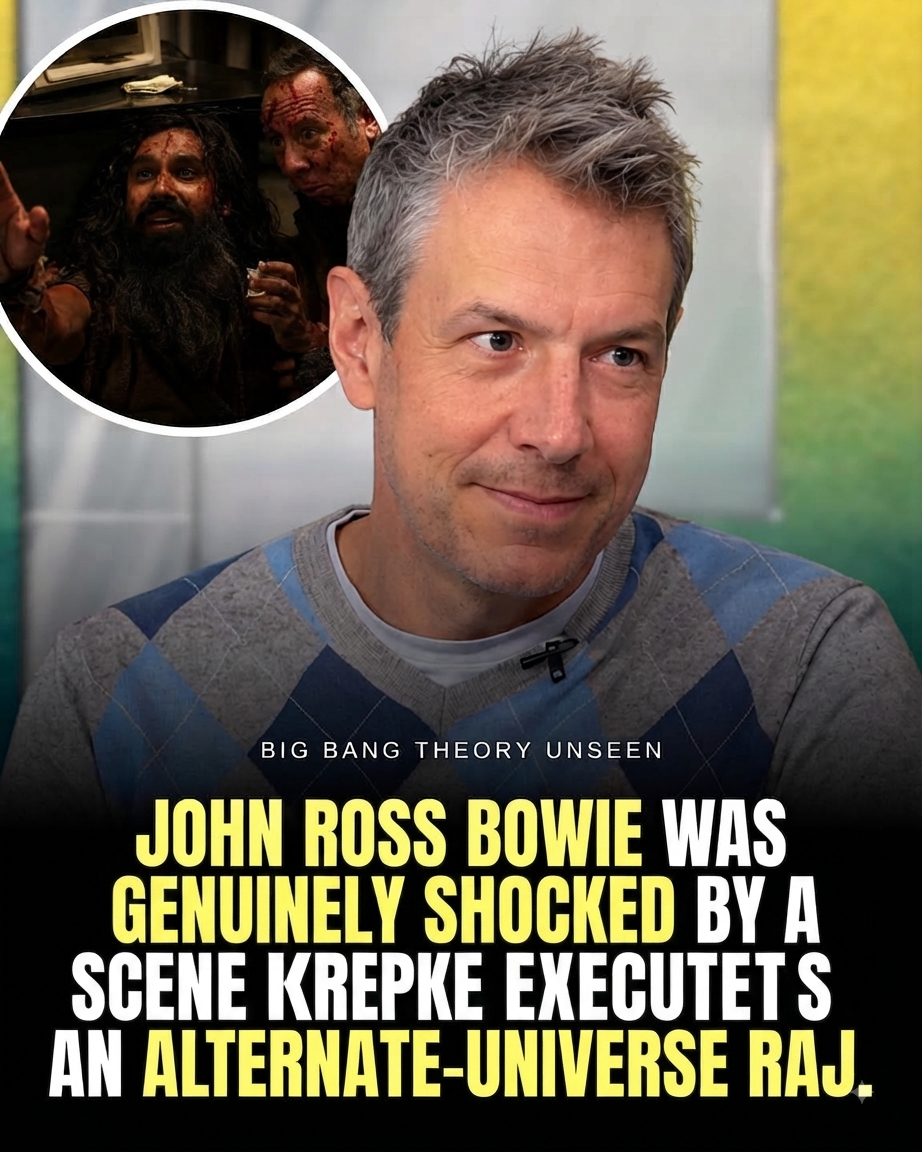
John Ross Bowie, who returns as Barry Kripke in a dramatically different form, admitted that reading the scene in the script genuinely rattled him.
And his reaction was remarkably simple.
Who shoots Kunal?
An Alternate Raj With a Very Different Life
The Raj appearing in Stuart Fails to Save the Universe isn't exactly the same Raj viewers spent twelve seasons getting to know.
This is an alternate-universe version of the character living under completely different circumstances.
Rather than being surrounded by his friends in Pasadena, this Raj has spent years imprisoned at Caltech under the control of an authoritarian version of Barry Kripke.
Kripke has transformed from the familiar obnoxious physicist into something much more sinister, taking on titles such as Grand Caliph and later Supreme Leader.
The change is deliberately absurd.
The same Kripke who once irritated Sheldon with his speech impediment and scientific rivalry has now become the ruler of an alternate world.
And Raj is one of the people trapped under his control.
That setup immediately establishes one of the show's biggest differences from the original sitcom.
The stakes are no longer simply romantic misunderstandings, roommate arguments, academic rivalries, or disagreements over who gets the couch.
This time, the fate of entire universes is involved.
Raj Finally Has the Answer
The most ironic part of Raj's story is that this alternate version of him appears to have achieved something the original Raj might have dreamed of.
He is incredibly important.
He possesses the mathematical knowledge necessary to help solve the multiverse crisis.
For perhaps the first time, Raj isn't simply the friend standing on the sidelines while Sheldon, Leonard, Amy, or another brilliant character figures out the solution.
He has the answer.
He matters.
He may actually be the key to saving everything.
And then the show takes that opportunity away from him almost immediately.
Just as Raj is about to reveal the crucial mathematical solution, Kripke shoots him.
The scene is shocking precisely because of how quickly the situation changes.
One moment Raj is potentially the person capable of saving the multiverse.
The next, he's dead.
John Ross Bowie Wasn't Ready for It
John Ross Bowie has played Barry Kripke for years, making him one of the actors most closely associated with the character.
But this version of Kripke presented an entirely different challenge.
Reading that he would be responsible for killing Raj wasn't something Bowie simply accepted without hesitation.
He admitted that he was "very, very taken aback" when he first read the script.
And even after filming the scene, he wasn't completely comfortable with what had happened.
His reaction was essentially one of disbelief:
"Who shoots Kunal?"
It's a funny comment, but it also reveals something about the relationship the cast had developed after spending so many years working together.
For the audience, Raj is a fictional character.
For Bowie, Kunal Nayyar is a longtime colleague and friend.
The idea of his character killing Nayyar's character therefore carried a strange emotional contradiction.
He could understand the story.
He could perform the scene.
But part of him still couldn't quite accept the fact that the script had actually asked him to do it.
Why Did the Writers Kill Raj?
The shocking death wasn't simply inserted for shock value.
Co-creator Bill Prady explained that the story required a character who had the necessary answer to the mathematical problem threatening the multiverse.
That character needed to be removed before he could use the solution.
Raj therefore became the logical choice.
From a storytelling perspective, the decision makes sense.
If the writers wanted to establish immediately that this universe was dangerous and unpredictable, killing a familiar character was an efficient way to communicate the stakes.
And because the audience already knew Raj, his death carried emotional weight.
A brand-new character dying in the first episode wouldn't have had the same impact.
Raj's death does.
The audience already knows him.
They already care about him.
And they know exactly what kind of person Kunal Nayyar's character represents within the larger franchise.
That familiarity makes the twist considerably more powerful.
The Multiverse Makes Death Complicated
Of course, there is one major advantage to killing a character in a multiverse story.
Technically, you're not necessarily saying goodbye to the character forever.
You're saying goodbye to this version of the character.
That's an important distinction.
The original Raj Koothrappali from The Big Bang Theory still exists within the franchise's established continuity.
The Raj who is killed is an alternate version from another universe.
That gives the writers enormous freedom.
They can make this universe darker, stranger, and considerably more dangerous without permanently rewriting the original sitcom's history.
It's one of the fundamental advantages of multiverse storytelling.
Characters can live radically different lives.
They can make different decisions.
They can become heroes.
They can become villains.
And, apparently, they can also be killed by alternate versions of characters their original selves merely found annoying.
Bowie Eventually Found a Way to Accept It
Bowie's initial discomfort eventually gave way to a rather amusing piece of multiverse logic.
If Raj's universe no longer exists, then perhaps the death technically doesn't matter.
And if there are infinite universes containing infinite versions of Raj, then one Raj dying represents an almost meaningless statistical event.
Bowie essentially came to view the death as a "rounding error."
It's a surprisingly philosophical way to deal with what is, on the surface, an extremely brutal sitcom-spinoff decision.
And it fits the show's new science-fiction framework perfectly.
In a normal sitcom, killing Raj would be an enormous permanent decision.
In a multiverse story, the writers can essentially say:
There are more of him.
Somewhere.
Probably.
Kripke's Transformation Makes It Even Stranger
Barry Kripke was never exactly a nice person on The Big Bang Theory.
He was competitive.
He enjoyed irritating Sheldon.
He had a habit of provoking people.
But he was still recognizably part of the same comedic universe as everyone else.
The alternate Kripke is something entirely different.
Turning him into a dictator exaggerates the character's existing personality traits until they become almost cartoonishly authoritarian.
And that is precisely what makes the idea work.
The audience already knows Kripke.
They understand his ego.
They understand his competitiveness.
They understand his relationship with Sheldon and the other scientists.
Then the spinoff asks:
What if all of that existed in a universe where Kripke actually had power?
The answer is apparently horrifying.
And Raj is one of the people who pays the price.
Bert Gets His Revenge
Raj's death doesn't mean the story simply forgets what happened.
Brian Posehn, who returns as Bert Kibbler, revealed that Bert eventually gets an opportunity for revenge against Kripke.
According to Posehn, Bert gets to "beat the st out of him."**
It's an appropriately chaotic response to an equally chaotic storyline.
Bert has always been one of the most underestimated characters in the Big Bang Theory universe.
The geologist was regularly mocked by the physicists, despite being intelligent, successful, and considerably more emotionally stable than many of them.
Putting Bert in a position where he gets to physically retaliate against a tyrannical Kripke is therefore a particularly satisfying reversal.
The quiet geologist gets his moment.
Kripke gets punished.
And Raj's death becomes part of the larger chain of events driving the story forward.
Kunal Nayyar's Return Is Still Significant
Even though this version of Raj has an incredibly short lifespan, Kunal Nayyar's involvement remains important.
Raj was one of the seven central characters who defined The Big Bang Theory.
His friendships with Howard, Sheldon, Leonard, and the rest of the group became some of the show's most enduring relationships.
Bringing Nayyar back allows the spinoff to establish a direct connection to that history while simultaneously demonstrating that it isn't simply trying to recreate the original sitcom.
This isn't the Raj viewers remember.
And that's the point.
The spinoff can use familiar actors and characters while placing them into completely unfamiliar circumstances.
That gives the franchise a sense of continuity without trapping it inside the same formula.
A Very Different Kind of Big Bang Theory Story
The original The Big Bang Theory was fundamentally a character comedy.
The biggest conflicts usually involved relationships, friendship, careers, family, or personality clashes.
Nobody was generally trying to conquer the universe.
Nobody needed to save reality.
And characters certainly weren't routinely being executed by authoritarian versions of their friends.
Stuart Fails to Save the Universe is deliberately changing that.
Its willingness to kill an alternate version of Raj in the first episode communicates something important about the show's ambitions.
It wants to use the Big Bang Theory universe as a starting point for something much bigger.
The familiar characters are still there.
The comedy is still there.
But the rules are different.
Why Raj's Death Works as a Storytelling Device
It may initially seem cruel to bring Kunal Nayyar back only to kill Raj.
But from a storytelling perspective, the decision accomplishes several things simultaneously.
First, it immediately establishes danger.
Second, it demonstrates that alternate universes genuinely have different consequences.
Third, it gives Kripke an unmistakably threatening introduction.
Fourth, it gives the remaining characters an emotional reason to keep fighting.
And finally, it tells the audience not to assume that familiar faces are automatically protected by nostalgia.
Anyone can be different.
Anyone can lose.
Anyone can die.
That's a bold message for the opening chapter of a spinoff.
No comments yet