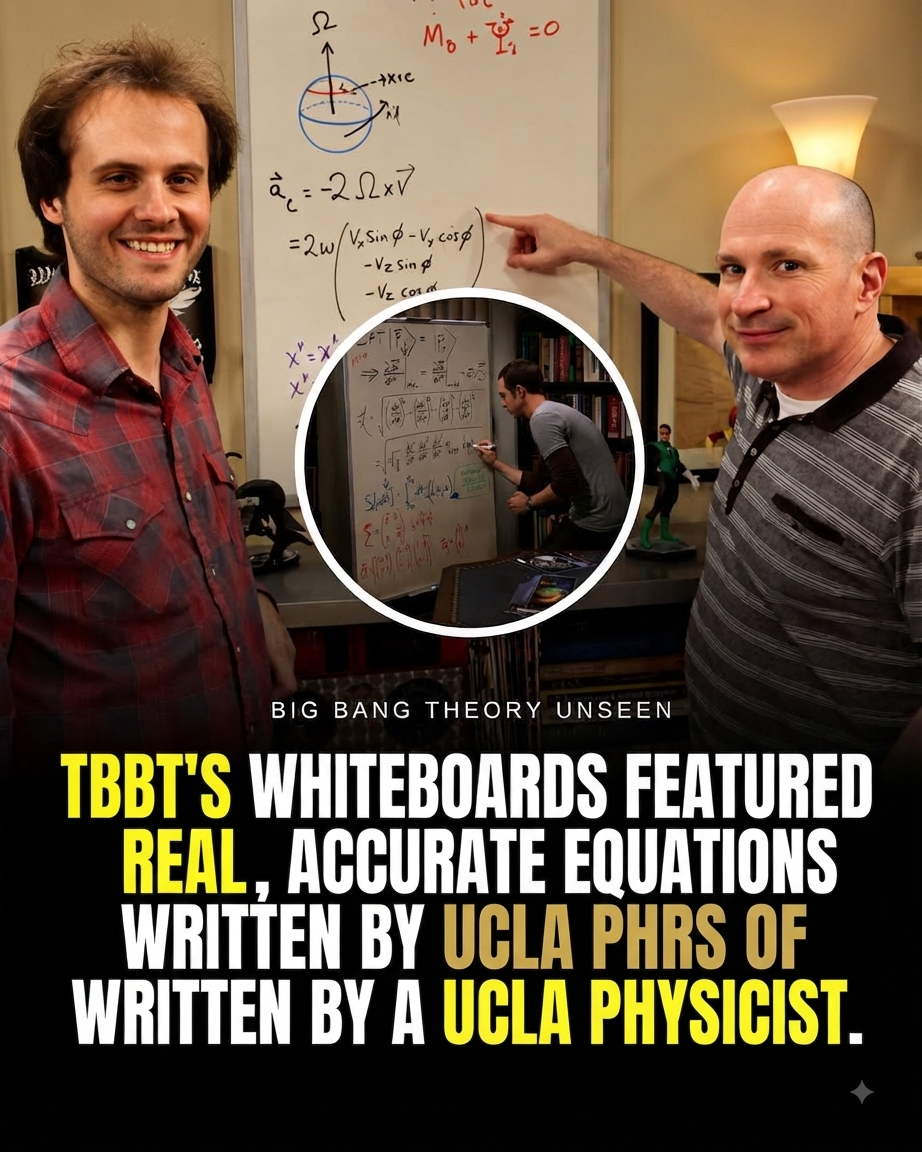
Behind Sheldon Cooper's extraordinary scientific knowledge was another brilliant mind viewers rarely saw—a real physicist whose work helped make the show's science remarkably authentic.
Jim Parsons had the difficult job of delivering Sheldon's complicated physics dialogue.
But someone else had to make sure those lines actually made sense.
That person was Dr. David Saltzberg, a physics and astronomy professor at UCLA who served as The Big Bang Theory's science consultant throughout its entire twelve-season run.
His contribution was far more important than simply checking whether Sheldon sounded intelligent.
He helped make sure the science actually was intelligent.
Meet Dr. David Saltzberg
Saltzberg was not a television writer pretending to understand physics.
He was an actual working physicist and academic.
His expertise gave the production something most sitcoms simply don't have: someone capable of looking at a complicated scientific conversation and immediately recognizing whether it was legitimate or complete nonsense.
That distinction mattered enormously on The Big Bang Theory.
The characters weren't merely described as scientists.
They were constantly discussing their research, debating theories, writing equations and working on genuine scientific problems.
The show needed those details to feel authentic.
He Helped Create the Science Behind the Scenes
One of Saltzberg's responsibilities was reviewing scripts and helping writers develop believable scientific material for the characters.
He could suggest research topics that physicists might realistically be working on.
He could correct terminology.
He could identify scientific problems in dialogue.
And perhaps most famously, he helped create the complicated equations that appeared throughout the series.
Those famous whiteboards weren't simply covered in random symbols.
They were designed to look like the work of actual scientists.
Those Whiteboards Were More Than Decoration
One of the easiest things for a television production to fake is a scientist's workspace.
Put a few equations on a whiteboard.
Add some Greek letters.
Throw in a diagram.
Most viewers will never question it.
The Big Bang Theory took a different approach.
Saltzberg ensured that many of the equations and scientific concepts seen on the show's sets were legitimate.
That meant viewers could pause an episode and discover that the apparently chaotic writing on the wall actually represented real mathematics or physics.
For a sitcom, that's an extraordinary level of attention to detail.
Jim Parsons Had to Learn the Language of Physics
This also helped explain why Sheldon's dialogue could sound so convincing.
Parsons wasn't actually a theoretical physicist.
He had to memorize Sheldon's highly technical lines and deliver them with enough confidence that audiences believed he had spent his entire life studying science.
Saltzberg's work provided the foundation.
Parsons provided the performance.
Together, they created a character who sounded like a genuine physicist—even when he was discussing extraordinarily complicated ideas in the middle of a comedy scene.
The Science Became Part of the Show's Identity
Scientific accuracy wasn't simply an occasional gimmick.
It became part of The Big Bang Theory's identity.
Physics wasn't something that appeared once in a while to establish that the characters were smart.
It was woven into the dialogue, props, jokes and storylines.
The characters could argue about scientific theories, discuss research papers, work on equations or casually reference complicated concepts as part of everyday conversation.
That required a level of consistency.
And Saltzberg helped provide it.
Real Scientists Could Recognize the Details
The show's commitment to authentic science also created an unexpected audience beyond sitcom fans.
Scientists and academics could recognize genuine concepts hidden inside the comedy.
For viewers without a physics background, the equations might simply look impressive.
For physicists, however, some of those details were immediately recognizable.
That gave the production an unusual credibility.
The jokes didn't need to be scientifically accurate for the comedy to work—but the writers and producers clearly wanted the world surrounding the characters to feel real.
A Quiet Contribution to a Massive Hit
Saltzberg wasn't one of the actors audiences saw every week.
He didn't have a character.
He didn't deliver punchlines.
His name wasn't part of the fictional world.
But his fingerprints were effectively everywhere.
Every convincing equation.
Every realistic research discussion.
Every scientific detail that survived the writers' room.
His work helped create the intellectual environment that made Sheldon, Leonard, Raj and Amy believable as scientists.
Final Thoughts
The Big Bang Theory was ultimately a comedy.
But the people behind it treated its scientific world with unusual seriousness.
Dr. David Saltzberg helped ensure that the physics wasn't simply decorative and that the equations weren't meaningless scribbles designed to look impressive on camera.
They were part of the show's commitment to authenticity.
So the next time you see Sheldon standing beside a complicated equation on a whiteboard, remember that there was another scientist behind the scene making sure it actually worked.
No comments yet