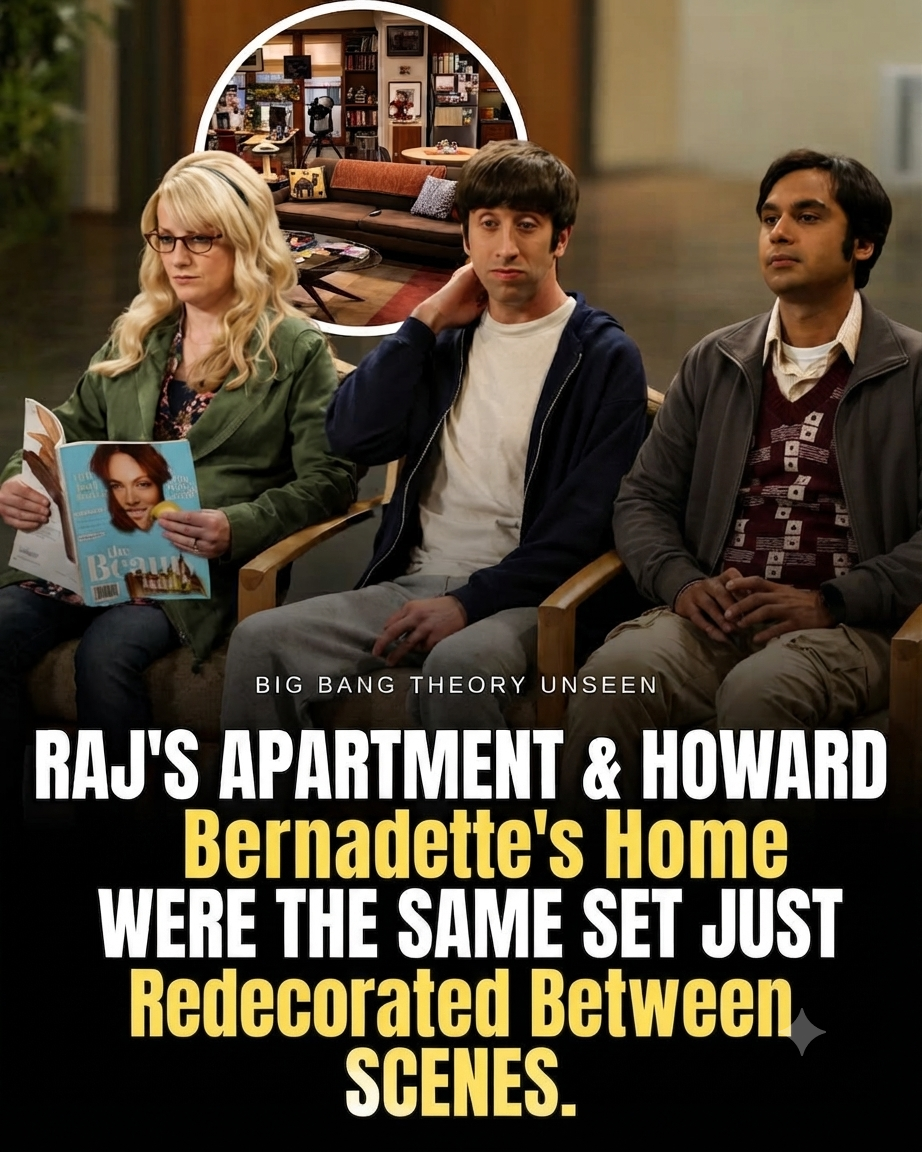
One of the most impressive tricks in television production is making viewers believe they're looking at an entire world when, in reality, much of it exists within a handful of carefully designed sets.
The Big Bang Theory was particularly skilled at this illusion, and one of its smartest behind-the-scenes secrets involved two locations fans visited countless times throughout the series.
Raj Koothrappali's apartment and the home shared by Howard and Bernadette Wolowitz may have appeared to be completely different places, but there was one surprising reality behind them:
They were actually the same set.
One Room, Two Different Homes
Rather than constructing two separate permanent sets, the production team used a single physical space for both locations.
Whenever filming required a switch between Raj's apartment and Howard and Bernadette's house, the crew completely transformed the room.
Furniture was moved.
Wall decorations were replaced.
Artwork, props, color palettes, and personal touches were all changed to reflect the personalities of the characters who supposedly lived there.
By the time the transformation was complete, audiences saw what looked like an entirely different home.
The illusion was so convincing that most viewers never suspected the two locations shared the same space.
The Work Behind the Transformation
Making one set look like two distinct homes required an enormous amount of effort from the production and set-design teams.
Every detail mattered.
Raj's apartment needed to reflect his tastes, lifestyle, and personality, while Howard and Bernadette's home required a completely different atmosphere.
The crew carefully adjusted everything from furniture placement to decorative accessories to ensure each location felt authentic and unique.
It was a remarkable example of how much behind-the-scenes craftsmanship goes into creating a believable television world.
Why You Rarely Saw Both Locations Together
Interestingly, this production decision created a noticeable pattern throughout the series.
Fans may not have consciously realized it, but episodes rarely featured both Raj's apartment and Howard and Bernadette's house in quick succession.
The reason was practical.
Showing both locations in the same production schedule would require the crew to completely redress the set multiple times.
That process took time and effort, making it far more efficient to avoid scripts that relied heavily on both locations during the same filming period.
As a result, the writers often structured episodes around one location or the other.
A Hidden Piece of Television Magic
What makes this secret so fascinating is how effectively it worked.
Across twelve seasons, viewers accepted both homes as separate, fully realized environments without ever questioning the illusion.
That's a testament not only to the show's production design but also to the countless crew members working behind the scenes.
While the actors received most of the attention, the visual world of The Big Bang Theory depended on talented designers, decorators, and technicians whose work often went unnoticed.
The Art of Creating a Sitcom World
Long-running sitcoms rely heavily on familiar locations.
Those spaces become almost as recognizable as the characters themselves.
For The Big Bang Theory, maintaining consistency across multiple apartments, workplaces, and gathering spots was essential to the show's success.
The fact that two of its most frequently used secondary locations were actually the same room in disguise makes the achievement even more impressive.


No comments yet