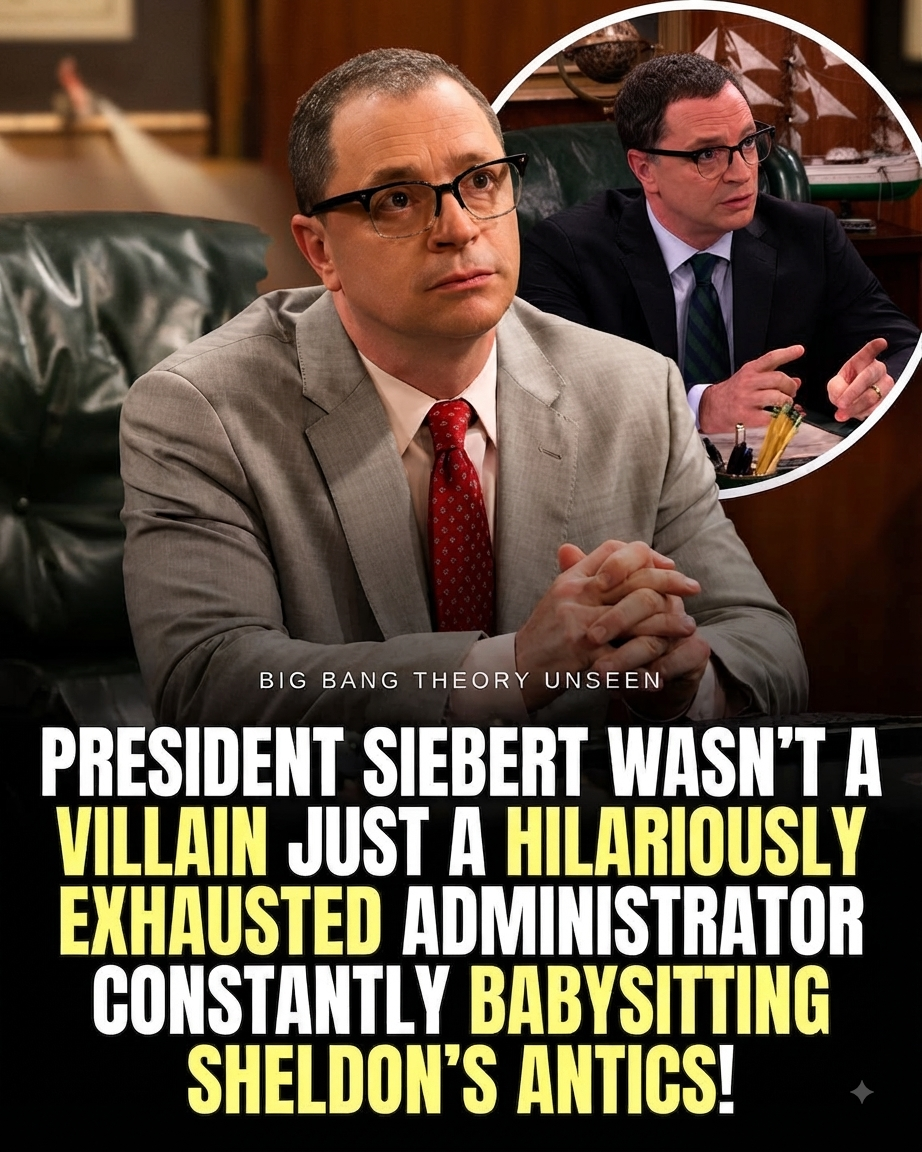
The Big Bang Theory was filled with brilliant scientists, eccentric personalities, complicated relationships, and more than its fair share of absurd situations. Yet one of its most quietly believable characters wasn't a physicist, a romantic partner, or one of the show's central seven. He was the exhausted administrator trying to keep all of them under control.
President Siebert, played by Joshua Malina, served as the president of Caltech throughout much of the series, appearing from Season 4 through the finale.
Unlike many sitcom authority figures, Siebert was rarely portrayed as an outright villain.
He wasn't evil.
He wasn't incompetent.
He wasn't secretly trying to sabotage Sheldon, Leonard, or the other scientists.
He was simply a university administrator with an extremely difficult job.
And then there was Sheldon Cooper.
That distinction is what made Siebert so entertaining.
He wasn't the obstacle standing between the show's characters and what they wanted.
He was the person who had to explain why what they wanted wasn't always possible.
In a show where virtually everyone was exceptionally intelligent, Siebert represented something surprisingly ordinary: the reality of dealing with institutions.
Who Was President Siebert?
President Siebert was the president of Caltech, the institution where Sheldon, Leonard, Raj, and several other major characters worked.
Played by Joshua Malina, Siebert brought an entirely different energy to the series.
He was intelligent enough to understand the scientists around him but practical enough to recognize that intelligence didn't automatically give someone permission to ignore every rule.
That made him particularly effective when dealing with Sheldon.
Sheldon often approached problems as though logic alone should determine the outcome.
Siebert knew better.
Universities have budgets.
Departments have politics.
Professors have responsibilities.
Administrators have limitations.
And somebody has to sign the paperwork.
That person was often Siebert.
He Wasn't Intimidated by Sheldon
One of the reasons President Siebert worked so well was that he didn't react to Sheldon the way many other characters did.
Sheldon could intimidate people with his intelligence.
He could overwhelm people with technical explanations.
He could become extraordinarily persistent when he believed he was right.
But Siebert had something Sheldon couldn't easily defeat with an argument:
institutional authority.
Sheldon could explain quantum physics for an hour.
Siebert could simply say no.
That created a wonderfully simple dynamic.
Sheldon would arrive with an elaborate demand.
Siebert would listen.
Sheldon would explain why the request was essential to scientific progress.
Siebert would remind him that the university had a budget.
Sheldon would become increasingly frustrated.
And Siebert would remain remarkably calm.
It was less a battle between genius and stupidity than a battle between genius and bureaucracy.
The $500 Million Funding Request
One of Siebert's most memorable interactions with Sheldon involved an absolutely outrageous funding request.
Sheldon once approached him seeking an enormous amount of money for scientific research, eventually asking for $500 million despite the original request being dramatically smaller.
It perfectly captured Sheldon's relationship with institutional funding.
To Sheldon, money wasn't really the issue.
Scientific progress was the issue.
If an experiment was important enough, he believed the university should simply find the money.
Siebert, understandably, saw things differently.
For an administrator responsible for an entire university, giving one physicist hundreds of millions of dollars wasn't exactly a routine budget adjustment.
The joke worked because both characters were operating from internally consistent perspectives.
Sheldon wasn't necessarily trying to be ridiculous.
He genuinely believed his research justified the expenditure.
Siebert wasn't trying to prevent scientific progress.
He simply understood that institutions don't work that way.
Siebert Understood Scientists Because He Was One
Another detail that made Siebert particularly believable was his own academic background.
The character was not some random bureaucrat who had somehow ended up running a world-class scientific institution.
Siebert held a doctorate in physics from Indiana University Bloomington.
That detail matters.
It meant he could actually understand the scientific world he was managing.
He wasn't simply telling Sheldon to stop because Sheldon was annoying.
He understood what Sheldon was talking about.
He understood the importance of the research.
He understood how talented the scientists at Caltech were.
And that probably made the job even more exhausting.
Imagine being surrounded by some of the brightest scientific minds in the world while simultaneously having to explain to them that they still need to follow university policies.
That was Siebert's life.
The Realistic Boss Behind the Comedy
Many sitcom bosses are written as caricatures.
They're either incompetent, cruel, ridiculously strict, or completely oblivious.
President Siebert was different.
He was recognizable.
Anyone who has worked in a university, research institution, corporation, hospital, or large organization can recognize the type.
He's the person who understands the value of your work but still has to ask whether there is money in the budget.
He's the person who supports your project but reminds you about institutional rules.
He's the person who has heard the same complaint five times and knows that you're probably going to come back tomorrow with another one.
That's what made Siebert feel real.
His frustration was never presented as hatred.
It was exhaustion.
Sheldon Was Probably His Biggest Challenge
Nobody created more problems for Siebert than Sheldon.
Sheldon didn't necessarily understand the concept of boundaries.
If he wanted something, he wanted it immediately.
If he believed a decision was wrong, he couldn't simply accept it.
And if he had a problem with someone, he had very little hesitation about explaining exactly why he thought they were wrong.
Siebert had to manage all of this while also running the university.
One of the funniest aspects of their relationship was the sheer variety of places where Sheldon would confront him.
Sheldon could appear in Siebert's office.
He could approach him in the hallway.
He could corner him in the restroom.
He could even show up at Siebert's home.
The location changed.
The problem remained the same.
Sheldon had a request.
Siebert had a headache.
The Arctic Circle Incident
One particularly absurd example involved Sheldon being exiled to the Arctic Circle.
For most people, being sent away to an extremely remote location would be enough to make them reconsider their behavior.
For Sheldon, it became another opportunity to contact Siebert.
Instead of simply accepting the consequences of his actions, Sheldon continued trying to negotiate.
The fact that he could eventually turn up at Siebert's home in the middle of the night only made the situation more ridiculous.
And yet, it was also perfectly consistent with Sheldon.
He wasn't necessarily malicious.
He simply had an almost complete inability to recognize when normal social boundaries should apply.
Siebert, meanwhile, had to deal with the consequences.
His Frustration Was Part of the Joke
One of Siebert's recurring jokes was his frustration with the language and behavior of the scientists around him.
His famous suggestion that perhaps the university needed a swear jar if it needed money captured the character perfectly.
It wasn't simply a joke about profanity.
It was a joke about his entire job.
Siebert was surrounded by people who could discuss the most advanced scientific theories imaginable but could sometimes behave like children when they didn't get what they wanted.
The contrast was hilarious.
These people could potentially change the world.
But they could also make an administrator want to scream.
Siebert Wasn't Anti-Science
It's important to understand that Siebert was never really against the scientists.
In fact, the opposite was true.
His job required him to protect the institution while supporting the people whose research gave Caltech its reputation.
That created an interesting balance.
He had to make sure Sheldon could conduct research without allowing Sheldon to completely ignore the university's rules.
He had to support Leonard and the other researchers while dealing with their individual personalities.
He had to manage funding, academic politics, personalities, expectations, and institutional responsibilities.
The scientists could focus on their work.
Siebert had to think about everything else.
Why Fans Relate to Siebert
This may be the biggest reason fans appreciate President Siebert.
He's one of the rare characters in the series who represents the ordinary frustrations of professional life.
Most of the main characters have extraordinary abilities.
Sheldon is a theoretical physicist.
Leonard is an experimental physicist.
Raj is an astrophysicist.
Amy is a neuroscientist.
Howard is an engineer and astronaut.
Their professional problems are often connected to their exceptional intelligence.
Siebert's problems are different.
He has to manage them.
That's a job almost anyone can understand.
You don't need to be a scientist to understand what it's like to have someone constantly asking for more money, more resources, more exceptions, or special treatment.
And you certainly don't need a doctorate to understand the exhaustion of saying no to someone who refuses to accept no as an answer.
The Perfect Counterbalance to Sheldon
From a storytelling perspective, Siebert also served an important function.
Sheldon needed someone who could push back against him without becoming a traditional antagonist.
If every character simply accepted Sheldon's behavior, the comedy would quickly become repetitive.
If someone constantly fought with Sheldon, the show would need a much more aggressive conflict structure.
Siebert occupied the middle ground.
He could tolerate Sheldon.
He could challenge Sheldon.
He could occasionally help Sheldon.
And he could tell Sheldon when he had gone too far.
That made him a perfect authority figure for the series.
He wasn't there to defeat Sheldon.
He was there to keep Sheldon from getting completely out of control.
Joshua Malina Made the Character Work
Joshua Malina's performance was another important part of Siebert's success.
Known for his work on shows such as The West Wing and Scandal, Malina brought an understated professionalism to the role.
He rarely needed to overplay Siebert's frustration.
A look, a pause, or a tired response was often enough.
That restraint made the character funnier.
Siebert didn't behave as though Sheldon were some unbelievable monster.
He behaved as though Sheldon were simply the most exhausting professor in a very long list of exhausting professors.
That realism gave their scenes an additional layer of comedy.
The Genius Needs an Administrator
The Big Bang Theory often celebrated genius.
It celebrated discovery.
It celebrated scientific curiosity.
It celebrated people who could look at an incredibly complicated problem and find an elegant solution.
But the show also quietly acknowledged something less glamorous.
Someone has to run the institution.
Someone has to approve the funding.
Someone has to enforce the rules.
Someone has to deal with the paperwork.
Someone has to tell Sheldon Cooper that he cannot simply do whatever he wants.
That someone was President Siebert.
And perhaps that is why his character remains so memorable despite never being one of the show's central figures.
Final Thoughts
President Siebert was never designed to be the villain of The Big Bang Theory.
He was something much more interesting.
He was the exhausted adult in the room.
While Sheldon, Leonard, Raj, Howard, Amy, and the others were busy changing the world through science, Siebert was trying to make sure the university didn't collapse under the weight of their personalities.
His doctorate meant he understood their brilliance.
His position meant he understood their limitations.
And his patience allowed him to survive both.
That made President Siebert one of the show's most believable authority figures and one of its most underrated recurring characters.
He didn't need to be evil.
He didn't need to hate Sheldon.
He didn't even need to win.
He simply needed to survive another meeting with him.
No comments yet