The Big Bang Theory Hid Brilliant Mathematical Easter Eggs on Apartment Doors That Most Fans Never Noticed
One of the reasons The Big Bang Theory became so beloved among science enthusiasts wasn't just its dialogue—it was the incredible attention to detail. Throughout its 12-season run, the writers quietly filled the series with hidden references to mathematics, physics, engineering, and pop culture. Some of the cleverest Easter eggs weren't spoken at all. They were sitting in plain sight on apartment doors, waiting for observant fans to notice.
To the average viewer, apartment numbers were simply part of the set design.
To mathematicians and science-fiction fans, however, they revealed another layer of the show's remarkable creativity.
Two of the smartest examples belonged to Amy Farrah Fowler and Wil Wheaton.
Amy's Apartment Number Was a Hidden Tribute to Pi
When Amy Farrah Fowler was introduced during the third-season finale, she quickly established herself as Sheldon's intellectual equal.
As a brilliant neurobiologist with a Ph.D., Amy naturally fit into the show's scientific world.
The writers even reflected that personality through something as ordinary as her address.
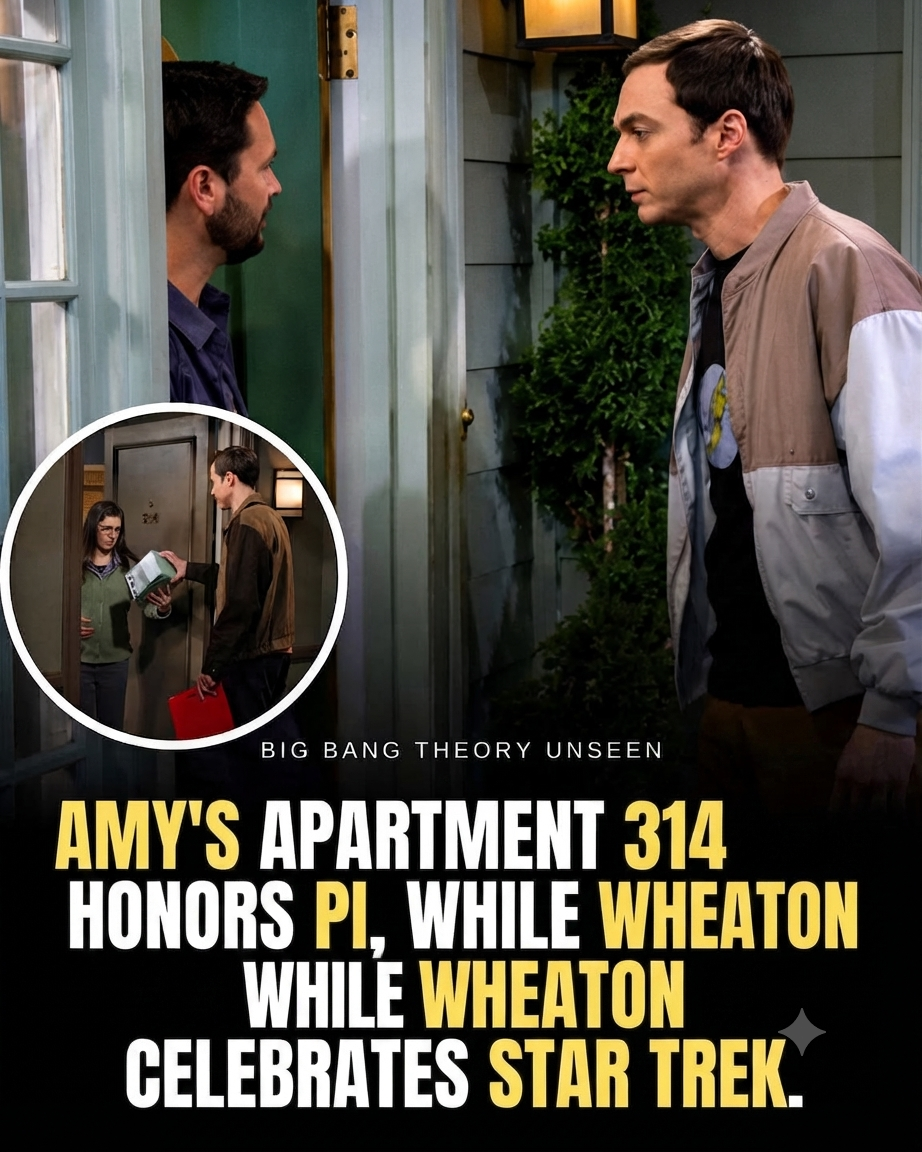
During the earlier seasons, Amy lives in Apartment 314.
At first glance, the number seems completely random.
It isn't.
The number 314 is an unmistakable reference to Pi (π), one of the most famous mathematical constants in history.
Pi begins:
3.141592653589793...
Since no apartment could realistically display an endless string of digits, the writers cleverly used the first three numbers.
It's a subtle joke that mathematicians immediately recognize while remaining almost invisible to everyone else.
A Perfect Detail for Amy Farrah Fowler
The reference wasn't chosen by accident.
Amy's character represents one of the most accomplished scientists in the series.
As a neurobiologist, she spends her career conducting advanced scientific research before eventually sharing the Nobel Prize in Physics alongside Sheldon Cooper.
Giving someone like Amy an apartment numbered 314 perfectly matches her personality.
It's exactly the kind of understated scientific humor The Big Bang Theory loved to include.
The joke never needed explaining.
If viewers recognized it, they enjoyed an extra laugh.
If they didn't, the story worked exactly the same.
That balance became one of the show's greatest strengths.
Wil Wheaton's Address Hid a Star Trek Legend
Amy wasn't the only character with a meaningful apartment number.
Another clever reference belonged to Wil Wheaton, who memorably played a fictionalized version of himself throughout the series.
Whenever audiences see Wheaton's residence, the apartment displays the number 1701.
Science-fiction fans immediately understand its significance.
NCC-1701 is the famous registry number of the USS Enterprise, one of the most recognizable starships in television history from Star Trek.
The Easter egg becomes even more fitting when considering Wheaton's own career.
Long before appearing on The Big Bang Theory, he became famous for portraying Wesley Crusher on Star Trek: The Next Generation.
His apartment number serves as both a tribute to his television legacy and a playful inside joke for longtime fans.
The Writers Loved Rewarding Observant Viewers
One of the defining characteristics of The Big Bang Theory was its willingness to include jokes that many viewers would never notice.
Scientific formulas written on whiteboards often contained genuine mathematics.
Physics discussions regularly referenced real scientific concepts.
Books, posters, comic books, equations, and props frequently rewarded viewers with specialized knowledge.
Apartment numbers became another example of that philosophy.
They weren't random decorations.
They were carefully selected details that reflected the personalities and histories of the people living behind those doors.
Why These Tiny Details Matter
Most sitcoms focus almost entirely on dialogue and character interactions.
The Big Bang Theory certainly excelled in those areas, but it also treated its production design as another storytelling tool.
Every set contained opportunities for visual jokes.
Whether it was Sheldon's meticulously organized apartment, the authentic scientific equations covering office whiteboards, or hidden numerical references on apartment doors, the creative team consistently demonstrated enormous respect for its audience.
They trusted viewers to discover these details naturally.
And when fans did, it made the fictional world feel even richer.
Science Was Always Part of the Show's DNA
The series never used science simply as decoration.
Scientific culture shaped the personalities, careers, friendships, and humor of nearly every main character.
Because of that, even seemingly insignificant production choices often carried deeper meaning.
Amy's apartment celebrating Pi wasn't merely a mathematical joke.
It reinforced who she was.
Likewise, Wil Wheaton's 1701 wasn't just a random number.
It acknowledged one of the actor's most famous roles while paying tribute to the science-fiction universe that helped inspire The Big Bang Theory itself.
The Hidden Genius Behind The Big Bang Theory
Over twelve seasons, fans have uncovered hundreds of Easter eggs scattered throughout the series.
Some appear in dialogue.
Others are hidden in costumes, props, bookshelves, computer screens, or background decorations.
These apartment numbers rank among the cleverest because they're always visible—yet incredibly easy to overlook.
Once you notice them, it's difficult to imagine they were ever accidental.
They're another reminder of just how carefully crafted every episode truly was.


No comments yet