Hollywood television is famously competitive when it comes to money. Actors negotiate individually, agents fight for the largest possible contracts, and the enormous success of a television series can create dramatic differences in what members of the same ensemble earn.
But The Big Bang Theory produced an unusually different story.
Before negotiating new contracts for the show's final seasons, five of its original stars made a decision that went against the most obvious financial instinct.
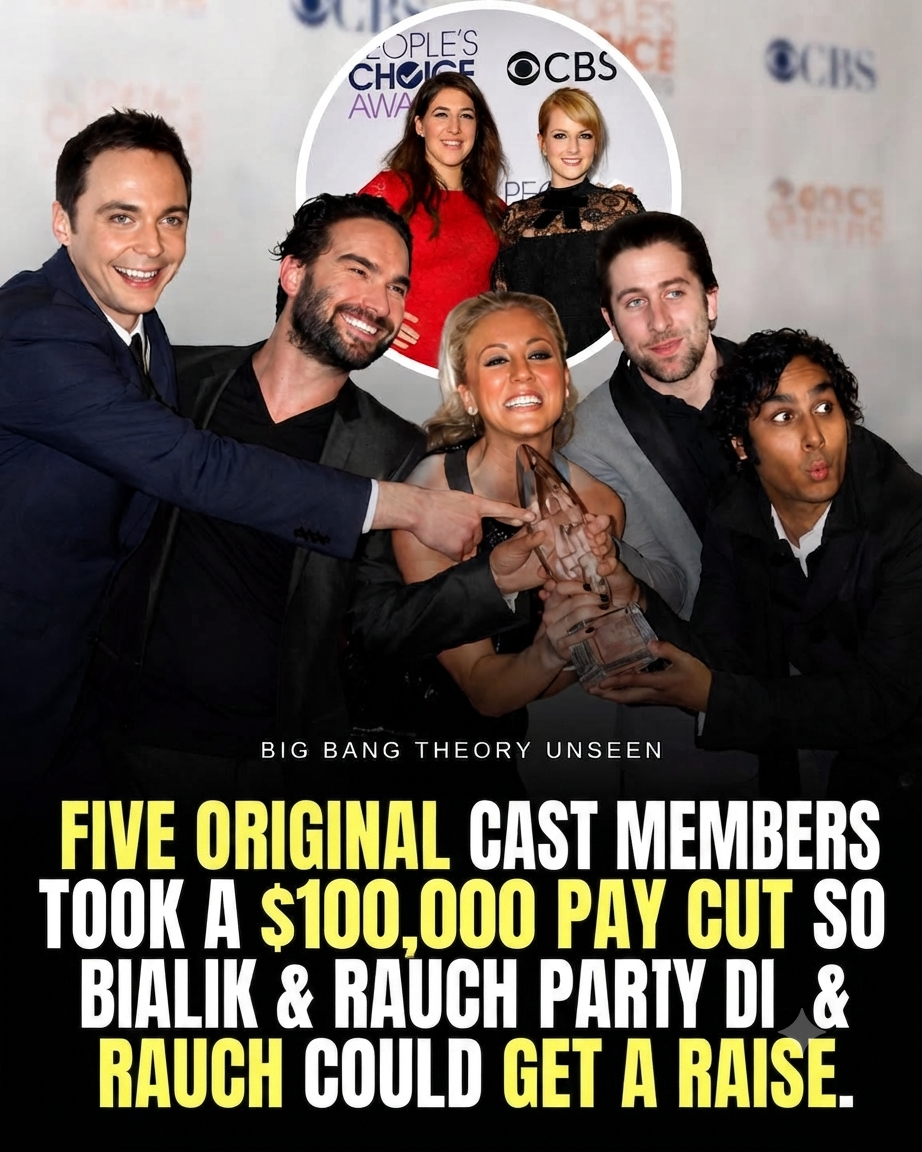
Jim Parsons, Johnny Galecki, Kaley Cuoco, Simon Helberg, and Kunal Nayyar were already among the highest-paid performers on television.
They were reportedly earning around $1 million per episode.
And rather than insisting on maintaining every dollar of that figure, the five actors voluntarily agreed to reduce their salaries.
The money they gave up was redirected toward two of their castmates:
Mayim Bialik and Melissa Rauch.
The two actresses had become enormously important to the series, but their salaries remained significantly below those of the original five.
So the cast did something remarkably unusual.
They gave up some of their own earnings so their colleagues could receive a substantial raise.
It wasn't perfect equality.
It didn't completely erase the salary gap.
But it was a powerful demonstration of ensemble solidarity.
The Salary Gap Had Become Impossible to Ignore
By the time The Big Bang Theory reached the later stages of its run, the cast had undergone a dramatic transformation.
When the series premiered, the central ensemble consisted primarily of Sheldon, Leonard, Penny, Howard, and Raj.
Mayim Bialik and Melissa Rauch arrived later.
Bialik first appeared as Amy Farrah Fowler toward the end of Season 3, while Rauch joined the show as Bernadette Rostenkowski around the same period.
Neither character was initially guaranteed a permanent place in the series.
But both became increasingly important.
Amy evolved from Sheldon's unusual blind-date match into one of the central characters of the entire show.
Bernadette went from Howard's sweet and seemingly timid girlfriend into a fiercely ambitious microbiologist, successful pharmaceutical professional, wife, and mother.
Their importance to the series grew enormously.
Their salaries, however, remained far behind those of the original five.
That created an increasingly obvious imbalance.
The Original Five Were Already Television's Biggest Earners
By 2017, The Big Bang Theory had become one of the most successful sitcoms in American television.
Jim Parsons, Johnny Galecki, and Kaley Cuoco had reached the extraordinary figure of approximately $1 million per episode.
Simon Helberg and Kunal Nayyar were also earning enormous salaries.
The original cast had enormous negotiating power because the success of the show depended heavily on the chemistry they had built together over the years.
But the five actors were also aware of how much the ensemble had changed.
Amy and Bernadette were no longer simply recurring additions.
They were part of the show's identity.
The series had become a seven-person ensemble in many ways.
And that reality created an uncomfortable financial question:
Should the women who had become essential to the show continue earning dramatically less than the five actors who had been there from the beginning?
The $100,000 Pay Cut
During contract negotiations in March 2017 for Seasons 11 and 12, the original five reportedly agreed to reduce their salaries by $100,000 per episode.
That meant dropping from approximately $1 million to around $900,000 per episode.
On the surface, the difference may sound relatively small compared with the enormous salaries involved.
But over an entire season, the numbers become significant.
And across five actors, the amount of money being redirected represented a substantial pool of additional compensation.
The purpose was clear.
The freed-up money would help increase the salaries of Mayim Bialik and Melissa Rauch.
It was an extraordinary gesture because none of the five actors had to make it.
They had already earned their negotiating position.
They had been with the show from the beginning.
They could have simply protected their own contracts.
Instead, they chose to give up part of their earnings.
Mayim Bialik and Melissa Rauch Were Already Essential
The decision becomes even more meaningful when you look at what Bialik and Rauch had contributed to the show.
Amy Farrah Fowler wasn't simply Sheldon's girlfriend.
Her relationship with Sheldon became one of the most important long-term character arcs in the series.
Through Amy, viewers saw Sheldon develop emotionally in ways that would have been almost unimaginable during the early seasons.
She challenged him.
She understood him.
She refused to simply accept his behavior.
And eventually, she became his wife and scientific partner.
Their relationship culminated in the Season 11 finale, when Sheldon and Amy were married.
Bernadette followed a similarly substantial transformation.
When she was introduced, Bernadette initially appeared to be a relatively conventional love interest for Howard.
But the writers gradually revealed a much more complicated character.
She was fiercely intelligent.
She was ambitious.
She had a doctorate in microbiology.
She built a successful career.
She became a wife and mother.
And she developed one of the show's most recognizable personalities.
By the final seasons, removing either character would have fundamentally changed the ensemble.
Bialik Had an Especially Impressive Resume
Mayim Bialik's situation was particularly interesting because her professional credentials extended beyond acting.
Bialik holds a PhD in neuroscience from UCLA, and her academic background made her casting as Amy especially appropriate.
She also received four consecutive Emmy nominations for her performance as Amy.
That recognition demonstrated how far the character had come.
She wasn't simply a supporting performer anymore.
She had become one of the show's most recognizable stars.
Yet her compensation reportedly remained far below the approximately $1 million-per-episode level commanded by the original trio of Parsons, Galecki, and Cuoco.
The salary negotiations therefore represented more than simply asking for a raise.
They reflected the changing value of the ensemble.
The Raise Was Significant — But Still Not Equal
The pay cut helped move Bialik and Rauch's salaries to more than $425,000 per episode.
That represented a dramatic increase from the approximately $200,000 per episode they had reportedly been making.
But there was an important limitation.
They still weren't earning the same amount as their five original castmates.
Both actresses had reportedly sought the full $1 million-per-episode figure.
Instead, they received a substantial increase that brought them much closer to their colleagues without completely eliminating the disparity.
That distinction matters.
The story isn't one of perfect salary equality.
It is a story of five extremely highly paid actors voluntarily sacrificing part of their own compensation to help two colleagues receive considerably more.
And that is what makes it unusual.
It Echoed Another Famous Sitcom
The situation inevitably drew comparisons to Friends.
The cast of Friends had famously negotiated together and eventually reached the landmark figure of $1 million per episode for each of its six principal stars.
That salary structure became one of the most famous examples of ensemble bargaining in television history.
The Big Bang Theory situation wasn't identical.
But the underlying principle was similar.
The performers understood that the show's success wasn't created by one individual.
It was an ensemble achievement.
The chemistry between the characters was part of the product.
The popularity of the series depended on the collective contribution of its cast.
That made the decision to redistribute some of the money especially significant.
Why the Gesture Mattered Beyond the Money
A $100,000-per-episode reduction is obviously meaningful financially.
But the symbolic significance may have been even greater.
The original five actors were essentially saying that the show's newer members had earned their place.
Mayim Bialik and Melissa Rauch weren't simply replacements or temporary additions.
They were colleagues who had helped carry the series through its later years.
The gesture acknowledged that reality.
It also demonstrated that the cast understood something important about long-running ensemble television:
A successful show becomes bigger than the people who started it.
Characters evolve.
Relationships change.
New performers become essential.
And eventually, the original structure of the series can look completely different from what it was in the pilot.
The Cast Had Already Built a Strong Working Relationship
Another reason the decision feels believable is the long history between the actors.
By 2017, the cast had spent years working together.
They had celebrated successes together.
They had experienced exhausting production schedules together.
They had watched the series become a global phenomenon.
And they had seen Bialik and Rauch transition from newcomers into integral members of the ensemble.
The decision therefore wasn't simply a financial calculation.
It was also a recognition of their shared history.
The original five could have viewed their position as something that had to be protected.
Instead, they chose to make room for the people who had become part of the show's later identity.
The Numbers Tell Only Part of the Story
It is easy to look at the figures and focus entirely on the enormous sums involved.
After all, $900,000 per episode is still an extraordinary salary.
And $425,000 per episode is still a remarkable amount of money.
But that perspective can miss the larger point.
The unusual part wasn't that the actors were earning less than $1 million.
The unusual part was why.
They weren't forced to accept the reduction because the show was struggling.
They weren't taking less because the network demanded it.
They voluntarily surrendered part of their own compensation to help their colleagues.
In an industry where individual earning power is often treated as a measure of personal success, that kind of collective thinking is relatively rare.
It Wasn't Perfect Equality
The story should also be viewed realistically.
The gesture did not completely eliminate the salary gap.
Bialik and Rauch still earned less than their five colleagues.
So describing the arrangement as complete pay equality would be inaccurate.
It wasn't.
But the five actors' decision still made a substantial difference.
Moving from roughly $200,000 to more than $425,000 per episode represented a dramatic improvement.
And without the original cast voluntarily reducing their own salaries, that increase might not have been possible in the same form.
That makes the gesture meaningful even without pretending it solved every issue.
A Sign of How Much Amy and Bernadette Had Changed the Show
Perhaps the most important part of the story is what it says about the evolution of The Big Bang Theory itself.
Amy and Bernadette had originally been additions.
By the later seasons, they were indispensable.
Amy helped transform Sheldon from an emotionally isolated genius into a man capable of genuine intimacy.
Bernadette helped transform Howard from one of the show's most immature characters into a husband, father, and successful professional.
Both women also helped expand the show's world beyond the original male friendships.
They created new combinations of characters.
They created new conflicts.
They created new jokes.
And they gave the series another emotional dimension.
The salary decision reflected that creative reality.
The Real Meaning of Ensemble Solidarity
The phrase "ensemble solidarity" can sometimes sound like industry jargon.
Here, however, it describes something very concrete.
Five actors had an opportunity to maximize their own earnings.
Instead, they chose to give something up.
The sacrifice wasn't enormous relative to their total earnings, but it was still a sacrifice.
And it directly benefited two colleagues.
That distinction is what makes the story memorable.
It wasn't charity.
It wasn't publicity.
It wasn't an obligatory gesture.
It was a professional decision made by people who understood that the success of the show was shared.
Final Thoughts
The story of The Big Bang Theory's salary negotiations is ultimately about much more than television money.
It is about how an ensemble changes over time.
Jim Parsons, Johnny Galecki, Kaley Cuoco, Simon Helberg, and Kunal Nayyar were the original core of the series. They built the show's foundation and became some of the highest-paid actors in television.
But Mayim Bialik and Melissa Rauch eventually became just as important to the show's identity in their own way.
Amy and Bernadette were no longer optional additions.
They were part of the heart of the series.
So when contract negotiations arrived in 2017, the original five made an unusual choice. Rather than holding onto every dollar of their enormous salaries, they agreed to reduce their pay by $100,000 per episode so Bialik and Rauch could receive substantial raises.
It wasn't perfect equality.
It didn't erase every difference.
And it didn't bring everyone to the same $1 million figure.
But it was still a rare example of successful television stars using their collective bargaining power to make sure their colleagues benefited too.
Five actors gave up some of what they were earning.
Two actresses received significantly more.
And an already successful ensemble demonstrated that success didn't necessarily have to be a zero-sum game.
They had already made millions from the show.
They didn't have to give anything back.
They chose to make room for the people who had helped make the show


No comments yet