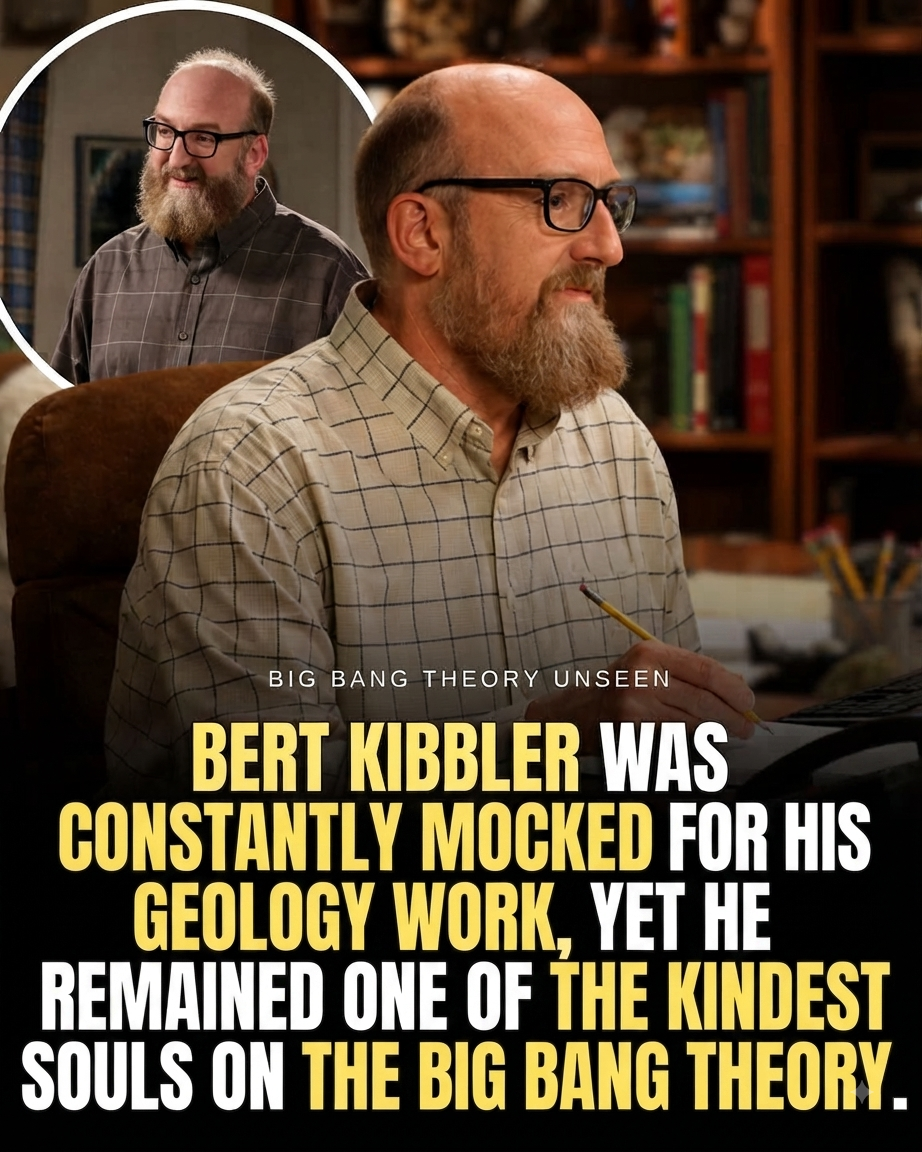
Bert Kibbler was introduced as one of The Big Bang Theory's easiest characters to laugh at, but the longer he remained part of the series, the harder it became to ignore just how genuinely decent he was.
Played by Brian Posehn, Bert was a towering, socially awkward geologist who existed on the outer edges of the show's central friend group.
He wasn't a world-famous physicist.
He wasn't a Nobel-winning scientist.
He wasn't particularly smooth with women.
And he certainly didn't possess Sheldon's ability to dominate every conversation with obscure scientific terminology.
Instead, Bert was frequently treated as the guy who simply didn't quite belong.
Yet that may be precisely what makes his character so interesting.
While Sheldon, Leonard, Howard, Raj, Amy, Bernadette, and Penny were all given extensive character development, Bert spent much of his time on the sidelines. He was frequently the target of jokes, particularly because the physicists viewed geology as intellectually inferior to their own fields.
But despite being mocked, excluded, and repeatedly reminded that he wasn't part of the group's scientific elite, Bert rarely responded with bitterness.
He remained kind.
He remained enthusiastic about his work.
And, perhaps most importantly, he continued treating the people around him with generosity even when they didn't always treat him the same way.
For many fans, that makes Bert Kibbler one of the show's most quietly wholesome characters.
The Scientist Everyone Underestimated
Bert's position within the group was unusual.
He was a scientist, but not the right kind of scientist according to Sheldon and the others.
The show's central characters were obsessed with theoretical physics, astrophysics, engineering, neuroscience, and related disciplines. Their scientific arguments often revolved around complicated theories and prestigious academic achievements.
Geology, by comparison, became an easy target.
Bert's profession was regularly dismissed as inferior, and the joke worked because the central characters genuinely believed their fields placed them on a higher intellectual level.
But there was an obvious irony underneath the comedy.
Bert was still a highly educated scientist with genuine expertise.
He had dedicated his career to understanding the Earth, rocks, minerals, and geological processes. His work mattered, his research mattered, and his academic achievements mattered.
The fact that the physicists didn't respect his field did not make Bert less intelligent.
It simply revealed their own arrogance.
And Bert never seemed particularly interested in proving them wrong.
He was comfortable being himself.
That quality made him fundamentally different from many of the show's other characters.
Bert Never Lost His Enthusiasm
One of Bert's most appealing qualities was his relationship with his work.
He genuinely loved geology.
Even when the others mocked his profession, Bert continued talking about his research with the enthusiasm of someone who had discovered something he truly enjoyed doing.
That passion made his character surprisingly relatable.
Not everyone gets to work in the most glamorous or prestigious field.
Not everyone receives constant recognition.
And not everyone has colleagues who understand or appreciate what they do.
Bert represented the person who continues doing something because they love it, even when other people don't consider it impressive.
His confidence wasn't based on being the smartest person in the room.
It came from being comfortable with who he was.
That made his interactions with Sheldon particularly entertaining.
Sheldon could be brutally dismissive toward Bert, but Bert rarely allowed those comments to fundamentally change his personality.
He might be awkward.
He might be lonely.
He might occasionally be confused by the social dynamics around him.
But he wasn't cruel.
And that distinction becomes increasingly important as the series progresses.
The Geology Jokes Revealed More About the Physicists Than Bert
The recurring jokes about geology were funny because they fit the personalities of the central characters.
Sheldon, Leonard, and the others had enormous intellectual egos.
They often judged people based on academic achievement and scientific specialization.
So when Bert appeared, his profession naturally became another opportunity for them to feel superior.
But viewed from a different perspective, the joke becomes much more revealing.
Bert didn't need to diminish anyone else's accomplishments to feel good about himself.
The physicists did.
That difference is one of the reasons Bert became so easy for audiences to root for.
He could take criticism without becoming cruel.
He could be rejected without turning vindictive.
And he could experience loneliness without allowing it to destroy his kindness.
Those are not insignificant qualities.
In fact, they may be some of the rarest qualities among the show's characters.
Bert's Loneliness Was Surprisingly Human
Behind much of Bert's comedy was something considerably more serious: loneliness.
Bert struggled romantically for much of his time on the show.
His size, awkwardness, limited social confidence, and unusual personality often made him an easy punchline.
The series could have turned that loneliness into something ugly.
Instead, Bert generally remained sympathetic.
He wanted companionship.
He wanted someone who appreciated him.
He wanted the same basic things that almost every other character wanted.
The difference was that Bert often had a much harder time finding them.
That made his character particularly effective because his awkwardness wasn't simply there for jokes.
There was a recognizable human being underneath it.
He was someone who could be overlooked in a crowded room despite having plenty to offer.
And unlike some characters who responded to rejection with anger or manipulation, Bert generally continued being Bert.
His Generosity Was One of His Best Qualities
Perhaps the strongest evidence for Bert's wholesome reputation comes from the way he treated his friends.
One particularly memorable example involved Raj.
When Raj was struggling financially, Bert offered to share his grant money with him.
That moment says a remarkable amount about Bert.
He wasn't wealthy simply for the sake of being wealthy.
He had earned his funding through his scientific work.
Yet when someone he cared about needed help, Bert was willing to share what he had.
He didn't need to make a dramatic speech about friendship.
He simply offered assistance.
That kind of generosity stands in sharp contrast to some of the more self-centered behavior displayed by the show's central characters.
Bert could be socially awkward, but when it actually mattered, he often understood friendship better than the people who considered themselves experts at it.
He Never Became Bitter
This may ultimately be Bert's greatest strength.
Imagine spending years around people who constantly tell you that your profession is inferior.
Imagine being the person everyone remembers when they need a punchline.
Imagine struggling romantically while watching your friends find relationships, marriages, and families.
Imagine being invited into a social circle but never completely feeling like you belong.
It would be understandable to become resentful.
Bert rarely did.
Even when the group treated him dismissively, he generally remained pleasant.
He continued participating.
He continued helping.
He continued being enthusiastic about geology.
And he continued looking for happiness.
That resilience is one of the reasons fans have increasingly reevaluated his character.
What initially looked like simple sitcom awkwardness can also be interpreted as remarkable emotional resilience.
Bert didn't allow other people's opinions to determine his value.
Bert's Happy Ending Felt Earned
Eventually, the show gave Bert something audiences had been waiting for: genuine romantic happiness.
His relationship with Judy and the stable domestic life that followed provided a satisfying payoff for a character who had spent so much of the series struggling with loneliness.
Importantly, his happy ending didn't require Bert to completely reinvent himself.
He didn't suddenly become charismatic.
He didn't transform into a different person.
He simply found someone who appreciated him.
That distinction matters.
Bert's story wasn't about becoming worthy of love.
He was worthy of love all along.
The problem was that he had spent years surrounded by people who didn't always recognize it.
His eventual happiness therefore felt less like a miraculous transformation and more like a reward for someone who had remained fundamentally decent despite years of disappointment.
Bert Was the Anti-Sheldon in Some Ways
One of the most interesting ways to look at Bert is to compare him with Sheldon.
Both are socially awkward.
Both are highly intelligent.
Both have unusual interests.
Both struggle with conventional social expectations.
But their personalities couldn't be more different.
Sheldon frequently believes his intelligence gives him permission to dismiss other people.
Bert doesn't.
Sheldon often expects others to accommodate him.
Bert usually tries to accommodate others.
Sheldon can become furious when people don't recognize his accomplishments.
Bert seems perfectly capable of enjoying his work without needing everyone around him to declare him brilliant.
In that sense, Bert represents a version of intellectualism without the ego.
He is intelligent without needing superiority.
He is passionate without being condescending.
And he is unusual without believing everyone else must adjust to him.
Brian Posehn Made Bert More Than a Punchline
Much of Bert's appeal also comes from Brian Posehn's performance.
Posehn understood that Bert worked best when he wasn't played as simply "the awkward guy."
There was always a sense that Bert was genuinely trying to connect with people.
His physical presence made him stand out immediately, but his performance gave the character warmth.
Bert's awkward pauses, uncertain expressions, enthusiasm about geology, and sometimes painfully straightforward observations made him feel like a person rather than a collection of jokes.
That distinction allowed audiences to eventually become invested in him.
The more Bert appeared, the less he felt like a temporary guest character and the more he became part of the larger world of the series.
Why Fans Continue Defending Bert
Bert's popularity among fans isn't necessarily because he is the funniest character.
It is because he feels genuine.
He doesn't constantly try to manipulate the people around him.
He doesn't need to win every argument.
He doesn't demand attention.
He doesn't pretend to be someone he isn't.
And even after being treated as an outsider, he doesn't spend his time plotting revenge.
In a show filled with characters who could be selfish, insecure, competitive, or emotionally complicated, Bert's basic decency becomes surprisingly refreshing.
He is flawed, awkward, and lonely.
But he is also generous, passionate, loyal, and kind.
That combination makes him one of the show's most human characters.
The Real Lesson Behind Bert Kibbler
Bert's storyline quietly challenges one of the recurring assumptions of The Big Bang Theory: that the smartest person in the room is automatically the most impressive.
Bert demonstrates that intelligence without kindness isn't necessarily admirable.
He may not have been the physicist with the most prestigious academic vocabulary.
He may not have been the person Sheldon wanted to impress.
But when friendship actually mattered, Bert often showed up with the qualities that mattered most.
He cared.
He helped.
He forgave.
And he kept going.
That's a different kind of intelligence, one that can't be measured with a degree or research grant.
Final Thoughts
Bert Kibbler may have entered The Big Bang Theory as a socially awkward geologist who was easy for the central characters to mock, but over time he became something much more interesting.
He represented the person who doesn't fit neatly into the social hierarchy.
The scientist whose field isn't considered prestigious enough.
The awkward friend who struggles to find love.
The outsider who keeps showing up anyway.
And perhaps most importantly, he remained kind.
The physicists could mock geology.
Sheldon could dismiss him.
The group could occasionally overlook him.
But Bert never allowed their opinions to define him.
His eventual happiness therefore felt especially satisfying because it didn't come from changing who he was. It came from finally finding people who appreciated the person he had been all along.
In a sitcom famous for its geniuses, Bert Kibbler quietly demonstrated that being a good person may be the most valuable quality of all.


No comments yet