Some guest appearances on The Big Bang Theory were designed primarily to deliver a joke.
Others were memorable because of the celebrity involved.
And then there were appearances that carried an emotional significance far beyond anything written in the script.
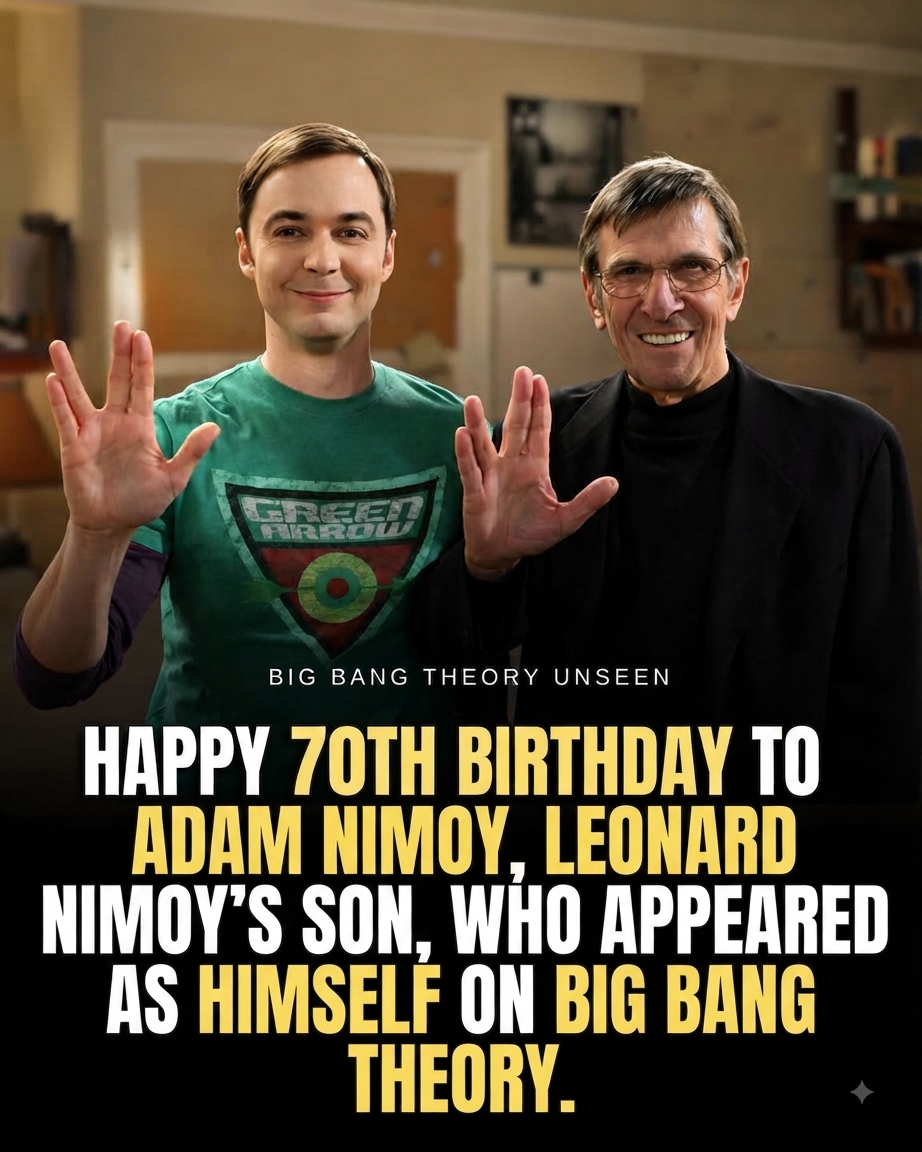
Adam Nimoy's appearance as himself in Season 9's "The Spock Resonance" belongs firmly in that final category.
On the surface, the episode was another wonderfully strange Big Bang Theory story. Sheldon Cooper finds himself involved in a documentary about the cultural legacy of Spock, the legendary Star Trek character portrayed by Leonard Nimoy.
But there was something profoundly different about seeing Adam Nimoy sitting across from Sheldon.
The episode aired on November 5, 2015 — only about nine months after Leonard Nimoy died in February of that year.
That timing gave Adam's appearance a significance that audiences could feel even when the episode returned to its usual comedy.
This wasn't simply a Star Trek connection.
It was a son appearing on a sitcom to discuss the legacy of his father.
And for a show that had already developed such a deep affection for Spock and Leonard Nimoy, the moment became something much more meaningful.
A Birthday That Connects Two Generations
Adam Nimoy was born on August 9, 1956.
Best known in entertainment circles for his work as a television director, Adam built a career that was very much his own, working on a wide range of television productions over several decades.
But his connection to Star Trek was impossible to separate entirely from his family history.
His father, Leonard Nimoy, had become one of television's most iconic performers through his portrayal of Spock.
That legacy was so enormous that it eventually became part of The Big Bang Theory itself.
Sheldon Cooper was an obsessive Star Trek fan.
Spock represented precisely the qualities Sheldon admired most: logic, intelligence, scientific curiosity, and emotional restraint.
So when Leonard Nimoy eventually became part of the show's universe, the connection felt almost inevitable.
What was less predictable was that Leonard's son would later become part of that story as well.
"The Spock Resonance" Was About More Than Spock
Season 9's "The Spock Resonance" was built around a documentary being produced about Spock's cultural legacy.
Adam Nimoy appears in the episode as himself, interviewing Sheldon about his father's influence.
For Sheldon, the opportunity is almost impossibly exciting.
This is Spock.
This is Leonard Nimoy.
This is the subject matter that Sheldon has spent much of his life obsessing over.
But beneath the comedy, another story is unfolding.
Sheldon is dealing with the emotional aftermath of his breakup with Amy.
And the contrast is important.
He is trying to discuss the cultural significance of a character associated with logic and emotional restraint while simultaneously struggling with emotions he doesn't know how to process himself.
That is exactly the kind of contradiction The Big Bang Theory used Sheldon to explore.
The Leonard Nimoy Napkin Makes the Moment Personal
One of the episode's most touching details involves the famous Leonard Nimoy-signed napkin.
The napkin had already become one of the show's most memorable pieces of Star Trek memorabilia.
Penny had previously given it to Sheldon, and it carried enormous significance for him because Leonard Nimoy had apparently used it and signed it.
For most people, a signed napkin would simply be an amusing piece of celebrity memorabilia.
For Sheldon, it was practically a sacred artifact.
But when Adam Nimoy appeared, the object took on another layer of meaning.
Sheldon was not simply discussing Leonard Nimoy's cultural impact with a stranger.
He was showing Leonard Nimoy's son an object connected to his father.
That small detail created an unexpectedly intimate bridge between Sheldon's fictional obsession and Leonard Nimoy's real-life legacy.
Leonard Nimoy Had Already Been Part of the Show
Adam's appearance wasn't actually the Nimoy family's first connection to The Big Bang Theory.
Years earlier, Leonard Nimoy himself had already appeared in the show's universe.
In Season 5's "The Transporter Malfunction," Nimoy provided his voice as a fictionalized version of himself.
The episode was built around Sheldon and Leonard's obsession with Star Trek collectibles, and Leonard Nimoy's involvement made the story especially memorable.
For Sheldon, hearing Nimoy's voice was an extraordinary experience.
For viewers, it was one of the show's cleverest celebrity appearances.
And it meant that by the time Adam Nimoy appeared in Season 9, the family connection had already been established.
The difference was that Adam's appearance came under completely different circumstances.
His father had died only months earlier.
That inevitably changed how the moment felt.
The Timing Made Everything More Poignant
Leonard Nimoy died on February 27, 2015.
"The Spock Resonance" aired later that same year.
That short gap is important.
Leonard Nimoy wasn't some distant figure from the show's past.
His death was still recent when the episode was filmed and broadcast.
For generations of Star Trek fans, the loss was enormous.
And for Adam Nimoy, it was personal in the most direct sense possible.
So watching him discuss his father's cultural legacy with Sheldon created an unusual collision between fiction and reality.
Sheldon was fascinated by Spock.
Adam was speaking about his father.
And audiences knew that Leonard Nimoy was no longer alive to participate himself.
That knowledge sits quietly underneath the episode.
The comedy remains.
But the emotional context is impossible to ignore.
Adam Nimoy Had His Own Impressive Television Career
It would be easy to describe Adam Nimoy simply as Leonard Nimoy's son.
But that would overlook the career he built independently.
Adam worked extensively as a television director, with credits across numerous recognizable series.
His directing work included shows such as NYPD Blue, Babylon 5, Sliders, Gilmore Girls, and The Outer Limits.
His connection to his father even extended into his directing career.
Adam directed an episode of The Outer Limits in which Leonard Nimoy appeared.
That creates another fascinating father-and-son connection.
Leonard had spent decades working in front of the camera.
Adam built his career behind it.
Yet their professional lives repeatedly crossed.
It is a relationship between two generations of television storytelling that makes Adam's eventual Big Bang Theory appearance even more appropriate.
He Also Directed Star Trek
Adam Nimoy's professional connection to the Star Trek universe wasn't limited to being Leonard Nimoy's son.
He also directed two episodes of Star Trek: The Next Generation.
That means the Nimoy family connection to Star Trek extended in multiple directions.
Leonard Nimoy became Spock.
Adam Nimoy became a director who worked within the Star Trek franchise.
And then Adam appeared on The Big Bang Theory, a show whose characters were famously obsessed with the world his father had helped make iconic.
It is almost too perfect.
Why Sheldon Was the Perfect Character for This Crossover
There was perhaps no better character on television to have this interaction with Adam Nimoy than Sheldon Cooper.
Sheldon didn't simply like Spock.
He understood Spock as an ideal.
Spock represented the intellectual, rational, emotionally controlled personality Sheldon admired.
But Sheldon was never actually Spock.
He was emotional.
He was insecure.
He became jealous.
He needed reassurance.
He loved his friends.
And, eventually, he fell deeply in love with Amy.
That made the documentary storyline particularly clever.
Sheldon was attempting to explain the appeal of Spock while his own emotional life was becoming increasingly complicated.
The character who wanted to be completely logical was being forced to confront the fact that human beings don't work that way.
A Real-Life Legacy Inside a Fictional One
The most interesting thing about Adam Nimoy's appearance is the way several different legacies overlap.
There is Leonard Nimoy's legacy as Spock.
There is Adam Nimoy's legacy as a director.
There is Sheldon's fictional obsession with Star Trek.
And there is The Big Bang Theory's own history of celebrating science fiction and the people who shaped it.
All of those threads meet in one relatively small episode.
That's why the appearance feels bigger than it initially seems.
It isn't simply a famous person appearing on a sitcom.
It is a real family legacy becoming part of a fictional character's obsession.
Leonard Nimoy's Connection to Sheldon Was Always Special
Throughout The Big Bang Theory, Sheldon was often portrayed as someone who had difficulty connecting emotionally with other people.
But his admiration for Spock was different.
Spock gave Sheldon a language through which he could understand himself.
The character represented a person who could be brilliant without being conventionally emotional.
That made Spock one of Sheldon's ultimate heroes.
Leonard Nimoy therefore represented something more significant to Sheldon than simply another famous actor.
He represented the person who had brought one of Sheldon's greatest fictional heroes to life.
That is why the signed napkin mattered so much.
And that is why Adam Nimoy's presence in the episode carried such unusual weight.
The Show Managed to Keep the Moment Respectful
One of the most impressive things about the episode is that it didn't need to turn Adam's appearance into an overly sentimental tribute.
The Big Bang Theory remained The Big Bang Theory.
There were jokes.
Sheldon remained Sheldon.
The documentary premise created plenty of comedic opportunities.
But underneath everything was an unmistakable sense of real-world significance.
The show allowed the connection to exist without forcing the audience to feel a particular emotion.
And perhaps that's why it works.
The sadness is there if you know the context.
The affection is there if you understand the history.
And the comedy remains intact.
A Multi-Generational Television Connection
Few television families have such an interesting connection to a fictional universe.
Leonard Nimoy became synonymous with Spock.
Adam Nimoy became a television director and later directed within the Star Trek franchise himself.
Then Adam appeared on The Big Bang Theory, speaking about his father's cultural legacy with one of television's biggest Star Trek fans.
It creates a fascinating three-generation relationship between actor, director, fictional character, and audience.
The connection feels especially fitting because The Big Bang Theory itself was built around the idea that popular culture can become part of someone's identity.
For Sheldon, Spock wasn't just entertainment.
It was part of how he understood the world.
Final Thoughts
Adam Nimoy's appearance on The Big Bang Theory may initially look like another clever celebrity guest spot.
But the context makes it something considerably more meaningful.
It came only months after the death of Leonard Nimoy, the actor who had turned Spock into one of the most recognizable characters in television history.
Adam wasn't simply appearing on a sitcom.
He was appearing as himself, discussing his father's cultural legacy with a fictional character who had spent years idolizing the role his father made famous.
And that character happened to be Sheldon Cooper — someone who understood Spock as an almost perfect representation of logic, intelligence, and emotional control while spending the same episode struggling with his own very human emotions.
The connection between the Nimoy family and The Big Bang Theory also stretched beyond that one episode.
Leonard Nimoy had already contributed to the show.
No comments yet